
1999
Musk’s $22 Million Payday; Compaq acquires Zip2 for $305 Million
NY Times (Archived) – Compaq Buys Zip2 to Enhance Altavista
Musk’s Million Dollar Car
Straight out of the multi-million dollar gate, Musk proved himself to be a bit of a douchebag.
Salon Article – Fast track: Elon Musk is poised to become Silicon Valley’s Next Big Thing. What put him in the driver’s seat?
If Elon Musk had bothered to surround himself with the public relations handlers who monitor the average Silicon Valley gazillionaire, he would never, ever have been caught on camera climbing into his new MacLaren F1. The MacLaren F1, with its gull-wing doors, rear engine and center-mounted driver’s seat, is essentially a road-ready version of a Formula 1 racer.
Interestingly, this 1999 Salon article is an early example of a couple of lies that helped shape the Myth of Musk. The first one (that he went without his parents’ support) is entirely fabricated, as his own mother recounts tales of “rent-controlled’ Canadian apartments and her own sacrifices to anyone who will listen. The second one, about why the Musk family left South Africa, is a lie the media has regularly repeated because they want it to be true. (It sounds “reasonable enough”.)
Having grown up in South Africa, the son of a South African engineer and a Canadian model, Musk left home at 17 to go to Kingston, Ontario, and enroll at Queen’s University. He went without his parents’ support, motivated in no small part by the distasteful prospect of compulsory service in the South African military. (“Who wants to serve in a fascist army?” Musk asks, reasonably enough.)
It’s unclear exactly when Musk purchased the $850,000 McLaren F1, but he had a CNN crew on hand when he took receipt:
Musk launches financial startup X.com
Wikipedia – X.com (bank)
2000
X.com merges with Confinity, Musk (as largest shareholder) is appointed CEO
In the beginning, they keep the x.com name.
Wikipedia – X.com (defunct bank)
Toralf Dittmann; Framesoft Ltd incorporated in Britain
Parent Company: Framesoft AG Software Applications (Switzerland)
- Framesoft AG; Langen Germany
- Framesoft Markeplaces AG; Zug, Switzerland
- Framesoft, LLC; New York, NY
Musk ousted as CEO while on his honeymoon in Australia, replaced by Peter Thiel
Wikipedia – X.com (defunct bank)
2001
X.com domain changed to PayPal.com
Wikipedia – X.com (bank)
Musk gives talk at Mars Society Convention, announces Mars greenhouse project (Pre-SpaceX)
In early 2001, Elon Musk met Robert Zubrin and donated $100,000 to his Mars Society, joining its board of directors for a short time. He gave a plenary talk at their fourth convention where he announced Mars Oasis, a project to land a greenhouse and grow plants on Mars.
Wikipedia
Musk goes to Moscow to buy a refurbished missile (Pre-SpaceX)
In late October 2001, Elon Musk went to Moscow to buy an intercontinental ballistic missile. He brought along Jim Cantrell, a kind of international aerospace supplies fixer, and Adeo Ressi, his best friend from Penn. Although Musk had tens of millions in the bank, he was trying to get a rocket on the cheap. They flew coach, and they were planning to buy a refurbished missile, not a new one. Musk figured it would be a good vehicle for sending a plant or some mice to Mars….
Excerpt from Ashlee Vance’s “Elon Musk: Tesla, SpaceX, and the Quest for a Fantastic Future”
2002
PayPal goes Public
E-Commerce Times – PayPal IPO Off to a Spectacular Start
Musk goes back to Moscow, still missile shopping (Pre-SpaceX)
… In February 2002 the group returned to Russia, this time bringing Mike Griffin, who had worked for the CIA’s venture capital arm, In-Q-Tel; NASA’s Jet Propulsion Laboratory; and was just leaving Orbital Sciences, a maker of satellites and spacecraft. Musk was now looking for not one but three missiles and had a briefcase full of cash, too. They met with Kosmotras officials in an ornate, neglected, prerevolutionary building near downtown Moscow. The vodka shots started—“To space!” “To America!”—and, a little buzzed, Musk asked point-blank how much a missile would cost. Eight million dollars each, they said. Musk countered, offering $8 million for two. “They sat there and looked at him,” Cantrell said. “And said something like, ‘Young boy. No.’ They also intimated that he didn’t have the money.” At this point, Musk had decided the Russians were either not serious about doing business or were just determined to part a dot-com millionaire from as much of his money as possible. He stormed out of the meeting.
The team went out into the snow and dreck of the Moscow winter, hailed a cab, and drove straight to the airport. The Russians were the only ones with rockets that could possibly fit within Musk’s budget, and they were too difficult to deal with. “It was a long drive,” Cantrell said. “We sat there in silence looking at the Russian peasants shopping in the snow.” The somber mood lingered all the way to the plane, until the drink cart arrived. “You always feel particularly good when the wheels lift off in Moscow,” Cantrell said. “It’s like, ‘My God. I made it.’ So, Griffin and I got drinks and clinked our glasses.” Musk sat in the row in front of them, typing on his computer. “We’re thinking, ‘F—ing nerd: What can he be doing now?’ ” At which point Musk wheeled around and flashed a spreadsheet he’d created.
“Hey, guys,” he said, “I think we can build this rocket ourselves.”
Excerpt from Ashlee Vance’s “Elon Musk: Tesla, SpaceX, and the Quest for a Fantastic Future”
‘Fuck it, we’ll do it live’ – SpaceX founded
SpaceX was founded by Elon Musk in 2002 with a vision of decreasing the costs of space launches, paving the way to a sustainable colony on Mars. In 2008, Falcon 1 successfully launched into orbit after three failed launch attempts. The company then pivoted towards the development of the larger Falcon 9 rocket and the Dragon 1 capsule to satisfy NASA’s COTS contracts for deliveries to the International Space Station.
Wikipedia – SpaceX
Ebay acquires PayPal for $1.5 Billion (Musk’s share $180 Million)
2003
Tesla Motors founded by 2 guys who aren’t Musk
2004
$7.5M Tesla Series A Funding – $6.5M from Musk
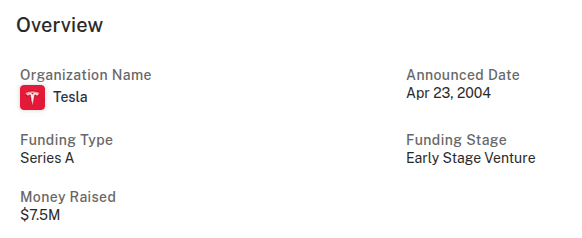
Musk became Chairman of the Board and Tesla’s largest shareholder. (Wikipedia – Tesla)
Musk wins GAO Protest, $227 Million NASA Contract rescinded for Kistler Aerospace
Rocket maker loses $227M deal (The Biz Journals)
NASA has dealt a serious blow to local rocket maker Kistler Aerospace Corp., withdrawing a contract that could have paid out $227 million through the end of 2006.
Kistler, operating with a small but high-profile core of about 20 engineers, is one of the nation’s top developers of reusable rockets. The National Aeronautics and Space Administration had looked to the company for insights into methods for supplying the International Space Station as the space shuttle is phased out, but the arrangement has been scuttled — at least for now — due to a federal contracting dispute.The setback could be serious for the Kirkland-based company, which is heavily indebted and last year sought Chapter 11 bankruptcy protection from creditors. Kistler still holds a previous NASA contract, which was awarded in 2001 but expires this summer. Currently no work is being done on it, according to a NASA spokeswoman, who added that the space agency has not yet decided if it will extend the existing Kistler contract beyond its expiration date.
The decision to withdraw the new Kistler-NASA arrangement comes just four months after the space agency proposed to pay Kistler as much as $227.4 million if it could lift its K-1 rocket into space in a series of launches and share the launch data with NASA. In February, NASA awarded the contract — modified from the earlier Kistler contract — to Kistler without opening it up to bids from other companies. NASA justified the approach by saying it already had a contract with Kistler, which had spent a decade designing its rocket. It also said that Kistler was the only commercial company that had developed the self-guiding system that NASA needed.
But a competitor — Space Exploration Technologies Corp., or SpaceX — protested to the U.S. General Accounting Office, the congressional agency that investigates complaints about government spending. In late June, the GAO told NASA it was siding with SpaceX, prompting the space agency to withdraw the no-bid arrangement with Kistler.
Kistler CEO George Mueller said the GAO also was concerned about the company’s financial ability to carry out a launch. When Kistler filed for bankruptcy protection in July 2003, it said it owed $600 million to creditors and had just $6.2 million in assets.
“It’s certainly not a step forward,” said Mueller of NASA’s decision.
But he said Kistler’s largest creditor, Bay Harbour Management LLC, continues to provide financial backing. Mueller said he expects Kistler to emerge from Chapter 11 with a reorganization plan in the next three or four months. After that, it will take the company another 15 to 18 months to finish assembling its rocket, which is based on reusable, kerosene-burning Russian rocket engines.
Once the rocket is ready, Kistler plans a launch from its base in Australia.
“That’s assuming we are funded,” Mueller said. “We are not going to do this without money.”
NASA is seeking the data to help the space agency develop a reusable space vehicle to supply the International Space Station after the space shuttle is phased out by 2010. Kistler was not under contract to deliver a vehicle to NASA, but Mueller said his company’s rocket would be suited for supplying the space station, launching satellites and other space missions.
Mueller said Kistler still is probably in the best position to provide NASA the data, because the company has been working on a program for several years.
Kistler had been planning to launch its rocket even before the NASA funding came along, said Mueller, who headed NASA’s Apollo Manned Space Flight Program from 1963 to 1969. He left to enter the private sector after the Apollo 12 launch, the second mission that landed men on the moon.
“Having the NASA contract was certainly helpful in raising money,” Mueller said. “But we never depended on them.”
At Kistler, Mueller has assembled a 21-member technical team of leading industry experts, including Joe Cuzzupoli, who was program manager for Rockwell International’s Space Shuttle Orbiter Project. The team also includes chief engineer Dick Kohrs, who worked on NASA’s Apollo, Shuttle, and Space Station programs.
Most of the actual rocket manufacturing was being handled by subcontractors, including a core of seven major suppliers. Lockheed Martin was building fuel tanks. Northrop Grumman Corp. was working on the rocket’s external skin, and Honeywell was involved with the rocket electronics. All now are unsecured creditors.
Mueller said the NASA funding was not guaranteed. Under the terms of the contract, Kistler was to be paid after it delivered data from launches, which Mueller said he still thinks his company can do.
Mueller said if Kistler can demonstrate it can launch its rocket, he is confident he will get NASA funding.
The company’s efforts are being bolstered by support from its chief creditor, Bay Harbour Management. In a joint statement, Douglas Teitelbaum, managing principal of the private equity firm, said he was committed to completing Kistler’s reorganization plan and that Kistler’s K-1 rocket remains NASA’s “best hope” to resupply the International Space Station.
Teitelbaum did not return a telephone message left at his New York office. But Mueller said Bay Harbour is Kistler’s largest secured lender and stands to lose $175 million if the program fails.
Despite a much larger potential payoff from NASA, to date Kistler has received a relatively small $7.7 million in space agency funding, said Melissa Mathews, a spokeswoman in the space agency’s Washington, D.C., offices.
In 2001 NASA awarded Kistler a competitive-bid contract for test data from one launch, Mathews said. In February, NASA modified the contract, adding options for four more flights and including some of the options from the original contract, Mathews said. The value of the modified contract was $227.4 million if NASA exercised all its options, Mathews said.
If NASA exercised all the options of the 2001 contract, it would add up to about $170 million. However, it remains undetermined whether NASA will opt to continue the contract after it expires in either this month or next, Mathews said. Mathews also said NASA has not decided if it will seek competitive bids from other companies in the wake of the GAO determination.
“This just happened last week, and we are still looking at our options,” Mathews said.
If NASA does open it up for bids, SpaceX will be interested, said Elon Musk, CEO of the company based in El Segundo, Calif.
Musk said he has nothing against Kistler, but he filed the GAO protest because he wanted his company to have a shot at the rocket funding.
SpaceX has its own rocket program and has a contract with the Pentagon to launch its partially reusable Falcon 1 rocket this fall carrying a Department of Defense satellite, said Musk.
Before launching SpaceX, Musk was a co-founder of the Internet business PayPal, which eBay purchased for more than $1 billion.
2005
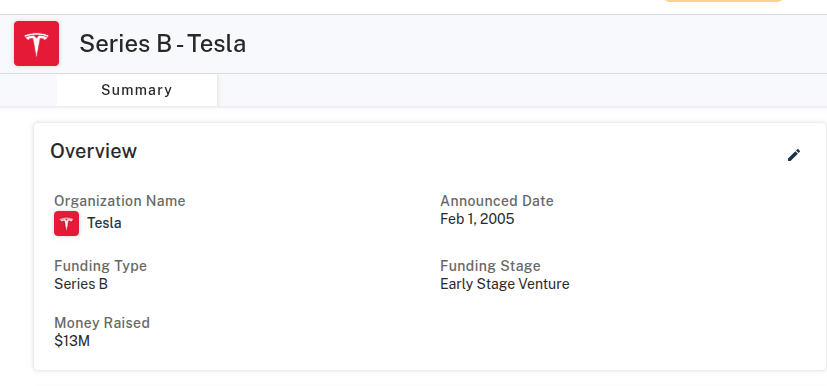
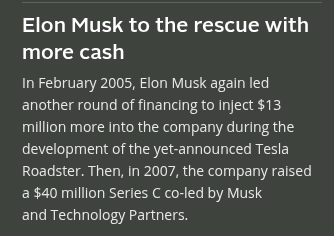
$13M Tesla Series B Funding – led by Musk
CRS – Issue Brief for Congress
One company, SpaceX, headed by Elon Musk (creator of PayPal), asserts that it will dramatically reduce the cost of reaching orbit with its partially reusable Falcon launch vehicle. The first Falcon launch, of a small DOD communications satellite, is scheduled for 2004.
CRS Issue Brief for Congress
Heated competition for DoD Contract has Musk threaten GAO protest in advance
DoD Small-Rocket Contract Produces Fierce Competition
Four U.S. companies are vying so fiercely for a Pentagon small-rocket contract that one already has threatened to appeal an aspect of the competition to the U.S. Government Accountability Office (GAO), which oversees government-sponsored competitions.
The contractors are bidding to build and launch prototype versions of their rockets in 2007 under the Pentagon’s Small Launch Vehicle initiative.
Pentagon officials plan to use the new class of cheap rockets to launch small satellites and also test components of an unmanned hypersonic vehicle that would be capable of destroying targets halfway around the world.
The Pentagon in July plans to choose one or more of the rocket companies , based on available funding, according to Candrea Thomas, a spokeswoman for the U.S. Air Force Space and Missile Systems Center in El Segundo, Calif. The Air Force oversees the Small Launch Vehicle program together with the Defense Advanced Research Projects Agency in Arlington, Va.
The Small Launch Vehicle competitors are Space Exploration Technologies Corp. (SpaceX) of El Segundo, Microcosm Inc. of El Segundo, Lockheed Martin Space Systems of New Orleans and Airlaunch LLC of Reno, Nev.
SpaceX plans to debut its Falcon 1 entrant in late July or August for another Pentagon customer. The two-stage Falcon 1 will boost the Pentagon’s Tactical Microsatellite Experiment (TacSat-1) spacecraft from Vandenberg Air Force Base, Calif. U.S. Pacific Command will use TacSat-1 to test the ability of commanders to control imaging satellites from the battlefield.
SpaceX built Falcon 1 almost entirely with private funds. The launch will be the first for the company founded by Elon Musk, who co-founded the Internet company PayPal.
Falcon 1 had been scheduled to debut in January 2004, but SpaceX repeatedly delayed the launch due to technical issues uncovered during pre-launch tests.
The Pentagon has challenged the Small Launch Vehicle competitors to build a vehicle that can carry small satellites to orbit for no more than $5 million per launch based on a flight rate of 20 flights per year. SpaceX advertises Falcon 1 at $5.9 million per launch.
After launching TacSat 1, SpaceX expects to launch an experimental satellite called Falconsat 2 in August or September.
Musk said he believes the time SpaceX has spent developing Falcon 1 and preparing it for launch gives military officials something tangible to evaluate compared with competing products.
“Our rocket is sitting on the pad right now. Theirs is sitting on a Power Point presentation,” Musk said.
Musk said that if the Pentagon were to select both the Falcon 1 and one of the other entrants, he would expect the government to reimburse SpaceX for its development costs. Otherwise, the government would be unfairly underwriting development of the competitor’s vehicle, he said. Procurement rules do not allow the military to subsidize one company’s concept during a competition without doing the same for other entries, Musk said.
If the Pentagon decided not to reimburse SpaceX, the company likely would protest to the GAO, Musk said.
Two former U.S. military procurement chiefs disagreed with Musk’s interpretation of federal acquisition rules.
Jacques Gansler, a former undersecretary of defense for acquisition, technology and logistics, said that the Pentagon is not bound to reimburse a company for internal research and development spending when another company has not invested similar funds.
SpaceX could choose to recoup that investment by factoring it into its price bid for the Small Launch Vehicle work, said Gansler, now a professor at the University of Maryland in College Park .
Alternatively, the company could take advantage of the work it has done by submitting a lower bid to increase its chances of winning, he said.
Paul Kaminski, another former acquisition chief, agreed that the Pentagon is not likely obligated to cover SpaceX’s development costs if it chooses two companies to move forward under the Falcon Small Launch Vehicle effort. However, not covering Musk’s development cost could work to SpaceX’s advantage by enabling the company to retain greater ownership of the intellectual property of its rocket for commercial use, Kaminski said.
Even if SpaceX is able to fly its Falcon 1 rocket successfully this year, the Air Force believes that there could be value in having another company build and demonstrate a rocket, wrote Thomas, the Air Force spokeswoman, in response to questions. Keeping competition in this area could help lower costs and drive further innovation, she said.
However, the Air Force is not committed to fielding two rocket families through the Small Launch Vehicle work as was done with Lockheed Martin Corp. and Boeing Co. in the Evolved Expendable Launch Vehicle program, Thomas said. The Air Force is asking Congress for $340 million in 2006 targeted specifically to keeping Lockheed Martin and Boeing in the launch business in case one company’s rocket fleet is grounded.
Thomas said the Air Force already has a second option for launching critical small payloads in an emergency: the Minotaur rocket . Made by Orbital Sciences Corp. of Dulles, Va., the Minotaur is capable of launching small payloads on short notice, albeit at a higher price than the Pentagon’s $5 million goal for the Falcon Small Launch Vehicle.
Meanwhile, Microcosm has been refining its Scorpius rocket concept over the years with small amounts of funding added to the Air Force budget by members of Congress, including the late Rep. Joe Skeen (R-N.M.).
The company is proposing a variant of the Scorpius family called Eagle for the Falcon Small Launch Vehicle competition.
Microcosm flew suborbital variants of Scorpius in 1999 and 2001 at White Sands Missile Range, N.M., and plans to conduct several engine tests this year, said Microcosm President James Wertz.
Lockheed Martin Space Systems is hoping to add to the company’s launch work through a win in the Falcon Small Launch Vehicle competition. Bob Simms, Lockheed Martin’s program manager for the effort, said that the company began work on its small vehicle concept at the onset of the Small Launch Vehicle competition in 2003.
The Small Launch Vehicle work complements, rather than threatens, its Atlas 5 rocket, said Simms. Small satellites may add some new capability but will not replace the functions of standard-sized spacecraft, he said.
Lockheed Martin fired the second stage motors for its vehicle in January and plans to conduct further motor tests this summer, Simms said.
Airlaunch LLC brings the only air-launched rocket to the competition. David Gump, the company’s chief marketing officer, said that using a military aircraft to launch the rocket will make it easier to place payloads in a variety of desired orbits.
Airlaunch’s QuickReach concept involves dropping a rocket from an unmodified Air Force C-17 cargo aircraft. The company will conduct tests this summer to ensure that the rocket does not strike the aircraft as it is dropped, Gump said.
Space News – DoD Small-Rocket Contract Produces Fierce Competition
2006
First Launch of Falcon 1 ends in failure
The launch took place on Saturday, March 24, 2006, at 22:30 UTC, from the SpaceX launch site on Omelek Island in the Marshall Islands. It ended in failure less than a minute into the flight because of a fuel line leak and subsequent fire.
Wikipedia – Falcon 1
$40M Tesla Series C Funding
“Musk co-led the third, $40 million round in May 2006 which saw investment from prominent entrepreneurs including Google co-founders Sergey Brin and Larry Page, and former eBay president Jeff Skoll.” Wikipedia

Musk’s cousins launch SolarCity w/ funding from Musk
Lyndon and Pete Rive are the sons of Maye Musk’s twin sister. It’s rather incredible how many white South Africans were able to tap into US government subsidies post-apartheid.
Founded on America’s birthday.

Musk feels slighted by media coverage
“The portrayal of my role to date has been incredibly insulting.”
“In an email to [VP of customer service and support] Harrigan on July 18, 2006, he wrote that he would “like to talk with every major publication within reason.”
He continued:
The way that my role as been portrayed to date, where I am referred to merely as ‘an early investor’ is outrageous. That would be like Martin [Eberhard] being called an ‘early employee.’
Apart from me leading the Series A & B and co-leading the Series C, my influence on the car itself runs from the headlights to the styling to the door sill to the trunk, and my strong interest in electric transport predates Tesla by a decade. Martin should certainly be the front and center guy, but the portrayal of my role to date has been incredibly insulting.
I’m not blaming you or others at Tesla — the media is difficult to control. However, we need to make a serious effort to correct this perception.
Business Insider
“Shortly thereafter, Musk took Harrigan aside, letting him know that if he wanted to keep his job with Tesla, he’d have to start getting him some recognition.”
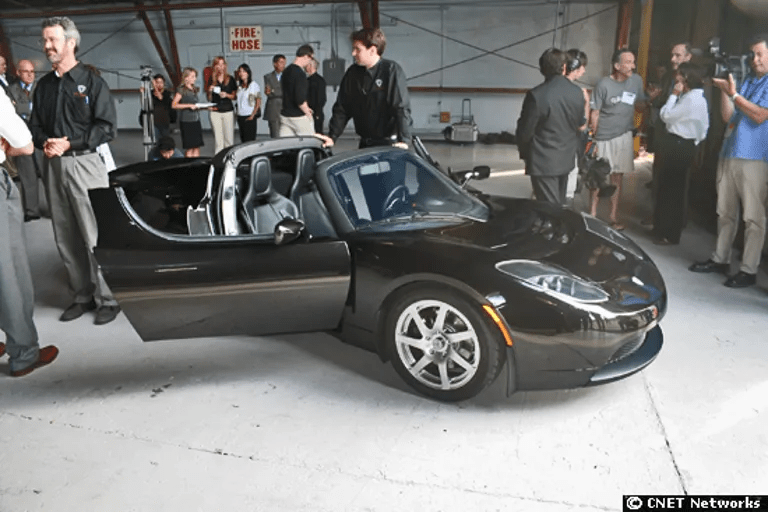
Tesla Roadster prototypes officially revealed
Hollywood responded. The 350-strong guest list included Ed Begley Jr., Michael Eisner, and Arnold Schwarzenegger, who was then governor of California. Everybody who came to the party was told to bring a checkbook. Tesla would be taking preorders for what they called the “Signature One Hundred” — 100 cars sold at $100,000 each with the signature of the company’s principles written on a plaque inside.
Business Insider
The “Secret Tesla Motors Master Plan”; ‘co-marketing’ with SolarCity
Blog by Elon Musk (Archived)
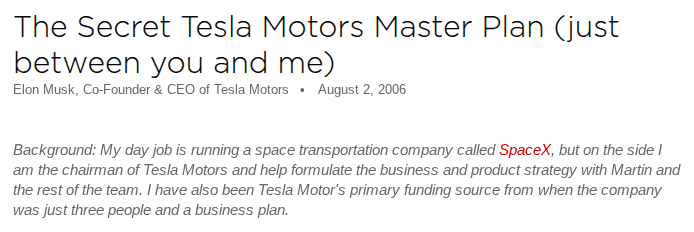
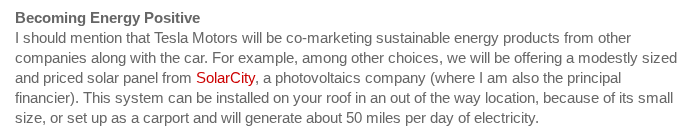
SolarCity began in 2006 and was co-founded by Lyndon Rive and Peter Rive, Musk’s cousins.
Under NASA program formed after Musk’s GAO Complaint, SpaceX wins contract
On 18 August 2006, NASA’s Exploration Systems Mission Directorate (ESMD) announced that SpaceX and Rocketplane Kistler won Phase I of the COTS program. NASA planned to engage winners in funded Space Act agreements through 2010.
Wikepedia – COTS
Mike Griffin, COTS, the X-Prize Cup Summit
The Head of NASA from 4/13/2005 – 1/20/2009; Accompanied Musk on his Moscow trip to try and buy ballistic missiles. (Worth noting, it seems Griffin has since turned on Musk.)
Thank you for inviting me to speak to you at this X-Prize Cup Summit. I want to congratulate Peter Diamandis and the other organizers of this event for bringing together this eclectic group. An insightful, and often all too apt, observation goes: “There are three types of people in the world. People who make things happen, people who watch things happen, and people who wonder what happened.” The group assembled here clearly fits into the first category, and so for my part, I’d like to spend some time with you this morning wondering what happened… More seriously, I believe this observation needs a fourth category, ahead of the three given above; first there must be the people who think about what ought to happen. These are the visionaries, and none of us would be here at this event today without them. So, I want to spend some time with you thinking about what needs to happen next.
All of you here will be familiar with our new Commercial Orbital Transportation Services (COTS) demonstrations, being conducted under the framework of NASA Space Act Agreements. These landmark agreements are, truly, NASA’s most significant investment to date in attempting to spur the development of the commercial space industry. But let me say this at the outset: NASA can do even better in partnering with the commercial and entrepreneurial space sector in carrying out our nation’s Vision for Space Exploration. However, let me be equally blunt about the other side of the coin: “partnership” with NASA is not a synonym for “helping NASA spend its money”. Just as with our international partnerships, I expect commercial and venture capital partners to have “skin in the game”, contributing resources toward a common goal that is greater than that which could be easily afforded by NASA alone, while figuring out how to make a profit from it!
Thus, it is important for the future that NASA’s investments productively leverage the engine of the American economy, a GDP valued at over $13 trillion per year, to help us carry out our mission of space exploration. As the President’s Science Advisor Jack Marburger stated earlier this year, “questions about the Vision boil down to whether we want to incorporate the Solar System in our economic sphere, or not.” I think that I can guess how most of you who are here today would answer that question. And, indeed, I have said in other venues that for me also, this is one of the core principles justifying human exploration and expansion into space.
But the kind of things we need to do have been done before. We know how it should go. Many of you have in the past heard me allude briefly to the story of how the U.S. Post Office Department, with the help of the War Department, helped spur our nation’s aviation industry when it started the air mail service routes in 1918. I very strongly believe that we can, and should, draw certain lessons from this event; that it can be a historical paradigm for how NASA might fill a similar role in spurring our emerging commercial space industry in concert with the goals of the Vision for Space Exploration. However, a review of this history shows that it was not an easy proposition then, and it is likely to be just as difficult to pursue in the present era. But, as President John Kennedy said at Rice University in 1962, we do these things, “not because they are easy, but because they are hard.” So let us look again at what was once done, and then let us think about what might yet be done.
The idea of an air mail service in the United States was initially proposed by the Post Office Department in 1912. However, Congress refused to grant them the $50,000 appropriation needed to start. Undaunted and persistent, the Post Office Department kept requesting funds from the Congress for an air mail service. Finally, in 1916, some funding was received, but when the Post Office Department invited bids for air mail routes in Massachusetts and Alaska, no company took them up on their offer, because no airplanes then in existence could meet the stringent requirements. Revising its plans, the Post Office Department and the Army finally demonstrated the first air mail route between Long Island, New York and Washington, D.C. in May 1918. It was a momentous occasion, and President Woodrow Wilson greeted the pilot upon landing. Today, if you walk along the Potomac River not far from the Jefferson Memorial, you will find several plaques commemorating those first air mail flights.
Using initially the then-plentiful Curtis Jenny trainers, surplus from the Great War, transcontinental air mail routes were quickly established. By the mid-1920s, the Post Office Department’s fleet was flying 2.5 million miles annually, delivering 14 million letters. This air mail service was popular because delivery times were much faster than could be accomplished using trains. However, there were also many fatalities during this barnstorming era. Cross-country flights in all kinds of weather and lighting conditions presented new and unsolved problems. The reason why pilots wore goggles and scarves in those open-air cockpits was hardly to look dashing. The goggles prevented bugs from striking the pilot’s eyes at 100 miles per hour, and the scarf was to cover the pilot’s mouth from the bugs that might fly in and to wipe away oil sputtering from the plane’s engine. Those of us who flew here to Las Cruces today should not take for granted our current level of aviation safety and comfort. Today, you have about the same chance of being killed by a lightning strike – about 100 Americans per year die this way – as in an air transport accident. But back then, aviation accidents and deaths were all too common.
In 1925, the Contract Air Mail Act (or Kelly Act) authorized the Postmaster General to contract for airmail services, and in the process spawned our nation’s nascent airline industry, as the airlines delivered both paying passengers and cargo. Charles Lindbergh was one of those early pilots, flying the route between Chicago and St. Louis in his de Havilland DH-4. His experiences flying the mail in these early years – including the bailouts and emergency landings – are recounted with both great literary grace and a pilot’s sense of immediacy in We, his autobiographical summary of those years. Lindbergh’s early experiences flying the mail gave him the experience he would need for his famous first non-stop flight from New York to Paris in 1927, winning the $25,000 Orteig Prize for himself and his backers.
But the story doesn’t end there. In 1933, President Roosevelt’s Postmaster General found unethical behavior in the awarding of these air mail contracts, and the President summarily canceled all such contracts and ordered the Army Air Corps to step in and take over the air mail service for a brief time. A young man by the name of James Webb, who was a lawyer and also a Marine Corps aviator himself, and who would later become NASA’s greatest Administrator, was closely involved in bringing order out of that chaos to re-start the commercial air mail service. This phase of Webb’s life is chronicled in his biography, Powering Apollo, by W. Henry Lambright.
So what are the lessons to be gleaned? First, the U.S. government acted through the Post Office Department as a major purchaser of potential air transport services, as opposed to being a technology developer. The aviation industry used the government’s investment to develop their commercial operations further, and along the way, incorporated numerous technical innovations that proceeded from the Ford tri-motor, to the Boeing 247, and eventually to the Douglas DC-3, generally considered to be the first practical commercial transport aircraft. These investments in soliciting actual air mail service, rather than in technology development itself, spurred innovation in retractable landing gear, radio navigation aids, aluminum monocoque structural design for low weight, low drag airframes, air-cooled radial engines, vacuum gyroscopes, and a slew of other technologies, while also delivering the mail, which was of course the intended primary goal. Technology development was the byproduct of this investment; it occurred as a natural result of competitive entrepreneurs attempting to out-do each other in servicing a known government market.
But second, we should remember that even as the Post Office Department was stimulating the development of aviation by purchasing commercial service, another arm of the U.S. government was doing its part from a different perspective. Aviation technology development was extensively aided and abetted by the activities of the National Advisory Committee for Aviation, or NACA, the predecessor of today’s NASA. Through its three research centers – first Langley, then later the Lewis and Ames laboratories – the NACA sponsored much of the groundbreaking technology development and proof-of-concept work, providing a base of feasible technical alternatives upon which industry could draw with each new airplane design. In my opinion, this private-public synergy achieved results both far better, and much faster, than either approach alone could have done.
So, what about space? We now have more than 50 years of investment, through both NASA and the DoD, in space technology and systems development. But what we have not had is a stable, predictable government market for space services sufficient to stimulate the development of a commercial space industry analogous to that which was seen in the growth of aviation. My hope is that with the seed money we are putting into the COTS program, we can demonstrate the possibility of commercial cargo and crew transportation to the International Space Station, and that subsequently NASA will be able to meet its ISS logistics needs by purchasing these demonstrated services. If we can do this, we will be able to change the paradigm for transportation services to be more in line with the air mail service of the 1920s, meeting the logistics needs of the ISS, some 7,000 to 10,000 kilograms per year, after the Space Shuttle is retired in 2010. In the process, we may be able to spur innovation for low-cost access to space. This is a carefully- considered investment with known risks that we can all see and appreciate, but with a potentially huge upside that makes it well worth the risks.
I’ll risk repeating myself to ensure that everyone fully understands how serious NASA takes the COTS demonstrations: if these commercial service capabilities are successfully demonstrated and cost-effective, NASA will welcome and use them. That is our default strategy for ISS re-supply. Most of you will probably agree that meeting or beating the government’s cost to provide space transportation services shouldn’t be too difficult for private industry to do. I hope you are right. I want these demonstrations to succeed; however, my wanting it won’t make it so. If these capabilities are not successfully demonstrated, then NASA’s fall-back position is to rely on the Orion Crew Exploration Vehicle or international partner cargo and crew service capabilities for ISS logistics support.
Now, there is another lesson to be derived from the airmail experience. For the space transportation services we seek, certain human rating and visiting vehicle requirements applicable to the ISS must be respected. To that end, we’re interested in hearing from potential commercial providers, like SpaceX and Rocketplane Kistler, as well as Lockheed Martin’s Orion team, concerning what requirements are necessary and value-added, and which ones may not be. The definition of human-rating is not simply how much paper and process we can afford to buy. That is the wrong metric. For this reason, we are reviewing the visiting vehicle and human rating requirements, not only for the COTS demonstration but also for the Crew Exploration Vehicle, to ensure that we’re writing our engineering specifications to achieve the goal of technical excellence, and are not simply following a handbook. Good engineers do not simply quote requirements from handbooks; we understand the underlying technical necessity behind such requirements.
Similarly, we must avoid relying solely on precedent, upon the mentality of “that’s the way we did it on Shuttle…”, or ISS, or Apollo, or Skylab, or whatever, as a substitute for good judgment. If we don’t periodically question our technical requirements, if we focus on process to the exclusion of outcome, if we substitute methodology for intent, then we will replicate the experience of the Post Office Department in its initial request for bids on air mail service: commercial industry will never be able to meet NASA’s stated needs. Thus, we must focus upon, and be experts in, systems engineering as we work through various technical issues for our future crew and cargo systems. We must be prepared to question our assumptions when necessary.
Yet another lesson gained from the air mail service was how it helped train a new generation of pilots like Wiley Post and Charles Lindbergh, engineers like Glenn Curtiss and Donald Douglas, and lawyers like future NASA Administrator Jim Webb. This barnstorming era engendered a certain sense of “air-mindedness” among the American people in much the same way that space tourism is rekindling an interest in space travel for the American public, over and above that which NASA accomplishes today. Of course, the physics and engineering are more difficult for personal space travel than for air travel, with even greater levels of cost and risk, but we must recognize that this change is occurring. There are now emerging certain rudimentary commercial capabilities for members of the public to have their own personal “space experience”, with varying degrees of weightlessness and views of the Earth and space. I fervently hope that the emergence of such capabilities will help make America more “space minded”.
Now, I must be clear that the development of space tourism is not a part of NASA’s charter. NASA was founded during the Cold War, soon after the launch of Sputnik, when the United States was in a race with the Soviets. NASA and the early civil space program were instruments of American preeminence in the world, at a time when an important component of such was seen to be preeminence in space. NASA achieved the goals that were set for it by the nation’s policymakers in that era, and did so with remarkable brilliance, so much so that even today we remain in awe of what the Apollo generation did. Now, some have since posited that NASA somehow failed the American public by not opening up the experience of space travel to the broader population. This is patent nonsense; the agency could not fail at something it was never asked to do. Such a mandate was simply never in NASA’s charter; if it were, I would question the wisdom of such a role for a government entity. However, as we go forward with the Vision for Space Exploration, it emphatically is our duty to encourage and leverage nascent commercial space capabilities. Not only is it the right thing to do in a country whose economic system is rooted in free market concepts, but it will also be a necessity if we are to achieve the goals set out for the U.S. civil space program.
A little over a year ago, I unveiled to the Congress and the public NASA’s architecture for returning to the Moon. It is a conservative plan, designed to accomplish the stated mission with minimum cost, maximum cost confidence, and as much use of existing systems as we could reasonably achieve. But having combed through the design trades, associated costs, and projected budget for the agency, it is apparent that NASA will need to leverage commercial and international partners to the maximum if we are to sustain this long journey, with footholds first on the International Space Station, then on the Moon, and from there onward to Mars. It is out of necessity for, not charity toward, commercial space endeavors that we at NASA must change our way of doing business. While I think that the $500 million we’re investing in the COTS demonstrations is a sizable first step, there’s more gold to be mined in other fields of commercial endeavor as well.
To that end, we are taking a hard look at our government-operated microgravity research aircraft at Johnson Space Center, and at what NASA requirements commercial providers can meet. We’ve purchased some commercial research flights from Zero-G Corporation in the past, and going forward, we are looking to meet the full set of our requirements through the purchase of private sector services at a lower cost. You recently saw a NASA Request for Information on micro-gravity flight services, and you can expect to see more from NASA in the coming months.
Commercial aircraft can make parabolic flights for 20-30 seconds of weightlessness at a time. I hope that future suborbital flights will soon be taking paying passengers to the edge of space for approximately four minutes of weightlessness, as well as a great view of the Earth from the edge of space. Using the air mail paradigm, NASA will purchase seats for these suborbital flights for certain experiments, and possibly astronaut candidate proficiency, if and when they become available. Just as NASA pilots fly T-38s and micro-gravity aircraft flights to maintain proficiency, we should consider how we might use these future suborbital flight opportunities. I have asked NASA Associate Administrator Rex Geveden to look into this capability under NASA’s Innovative Partnership Program. Rex also oversees management of NASA’s Centennial Challenge prize program, authorized by the Congress last December. Several NASA prize challenges, like the lunar lander, will be featured here at the X-Prize Cup over the next several days. The spirit and heritage of these prizes harks back to Charles Lindbergh’s successful bid for the Orteig Prize in 1927; I hope these new prizes spark similar accomplishments.
In another vein, the NASA Authorization Act of 2005 also designates the U.S. segment of the International Space Station a national laboratory. NASA is actively seeking commercial partners who would like to use the ISS for their own experiments. After the loss of Space Shuttle Columbia, NASA was forced to curtail a great deal of ISS research, and with our focus on the use of the Space Shuttle system for ISS assembly over the next few years, I believe that commercial cargo and crew services will prove invaluable for increasing access to space and to the ISS for these commercial experiments.
Also in connection with the ISS, we need to be open to novel concepts which can enhance the utility of this multi-billion dollar facility. As one example, former astronaut and present-day entrepreneur Franklin Chang-Diaz, creator and proponent of the Vasimir electric propulsion concept, has opened discussions with NASA in connection with the possible use of the Vasimir engine for ISS orbit maintenance. We don’t know, yet, whether this particular approach makes sense or not, but if it does, there might be a classic “win-win” strategy here; we gain experience with a potentially useful space propulsion concept, and we reduce the amount of propellant delivery needed for ISS reboost, leaving room in the logistics manifest for more productive cargo. This is the kind of private-public synergy that can serve us well.
While we are on the theme of innovative approaches to commercial space endeavors, I want to congratulate Pete Worden and his team at Ames for working with Bigelow Aerospace to secure a piggyback ride for their Genebox experiment on Bigelow’s Genesis inflatable space habitat demonstration. I believe that this is one of many innovative, short turnaround ideas that we’ll be seeing from Pete over the next several years. He is turning Ames Research Center in Silicon Valley into a “Mecca” for space entrepreneurs, where among other things we are hosting the Red Planet venture capital fund, similar in some ways to the CIA’s In-Q-Tel operation, to leverage innovators and investors who have not typically done business with NASA.
It should be no surprise to anyone here that in my first few weeks as NASA Administrator, I met with Burt Rutan, Elon Musk, Bob Bigelow, and other space entrepreneurs to hear their ideas, or that I want a healthy, pragmatic dialogue between NASA and the commercial and entrepreneurial space community. Several people on my senior management team, including Shana Dale, Rex Geveden, Scott Pace, Pete Worden, Bill Claybaugh, Chris Shank, and numerous others are intimately familiar with the concerns of the commercial space community, and we are also realists. We are mindful of the pitfalls (and frankly, pratfalls) of all too many endeavors between space companies and NASA.
Recalling again the lessons of the air mail service in 1933, we know that we must avoid any real or perceived favoritism before entering into any joint endeavors. There must be a healthy competition of ideas and resources. Before making commitments, we must carefully consider and ensure that joint endeavors are properly aligned with NASA’s mission, are of sufficiently high priority, and can be done within the resources provided to NASA. Now, I specifically want to emphasize that the phrase “carefully considered” is not a euphemism for hiding behind bureaucratic process or legalistic red tape. If you see this happening, we want to hear about it. Having worked in industry, I appreciate the need to meet a payroll, and I know well how the timing of government decisions affects your “skin in the game.” For this reason, clear dialogue is necessary between NASA and the parties involved when exploring possible joint endeavors. We must not over-promise or over-commit. It is one thing to begin an endeavor, but it is an even greater accomplishment to complete it! Too many exciting endeavors at NASA have failed to meet this standard in recent years. We must re-establish NASA’s reputation for finishing what we start.
As I stated earlier, there are people who make things happen, people who watch things happen, and people who wonder what happened. I’ll share with you another of my favorite aphorisms: managers do things right, but leaders do the right things. So, we need to make things happen, but we also need to make sure that we’re trying to make the right things happen. The lessons learned from our nation’s first steps in creating a commercial air mail service are useful to us today. So, let me leave you with a final thought from a certain air mail pilot, one Charles Lindbergh: “It is the greatest shot of adrenaline to be doing what you have wanted to do so badly. You almost feel like you could fly without the plane.” The group assembled here today knows that feeling. So, let’s make things happen, so that we can enjoy it more often!
Thank you.
Archived – X Prize Comments by Mike Griffin
2007
Second Launch of Falcon 1 ends in failure
The first launch attempt on March 21, 2007, was aborted at 00:05 GMT at the last second before launch and after the engine had ignited. It was, however, decided that another launch should be made the same day. The rocket successfully left the launch pad at 01:10 GMT on March 21, 2007, with a DemoSat payload for DARPA and NASA. The rocket performed well during the first-stage burn. However, during staging, the interstage fairing on the top of the first stage bumped the second-stage engine bell. The bump occurred as the second-stage nozzle exited the interstage, with the first stage rotating much faster than expected (a rotation rate of about 2.5°/s vs. expected rate of 0.5°/s maximum), thereby making contact with the niobium nozzle of the second stage.
Wikipedia – Falcon 1
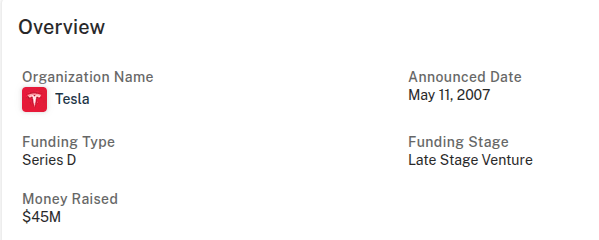
$45M Tesla Series D Funding
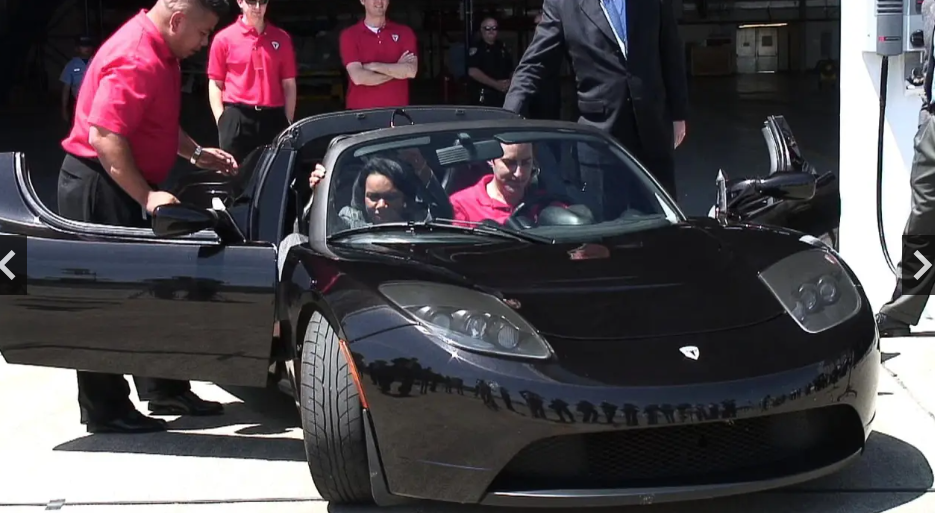
SEC of State Condoleeza Rice goes for ride in a Roadster
Tesla Board, led by Musk, asks Martin Eberhard to step down as CEO
“Michael Marks, the former CEO of contract manufacturer Flextronics, has stepped in to become the interim chief executive of electric sports car company Tesla Motors. Founder and current CEO Martin Eberhard will become president of technology.”
2008
Tesla Founders Eberhard & Tarpenning leave company
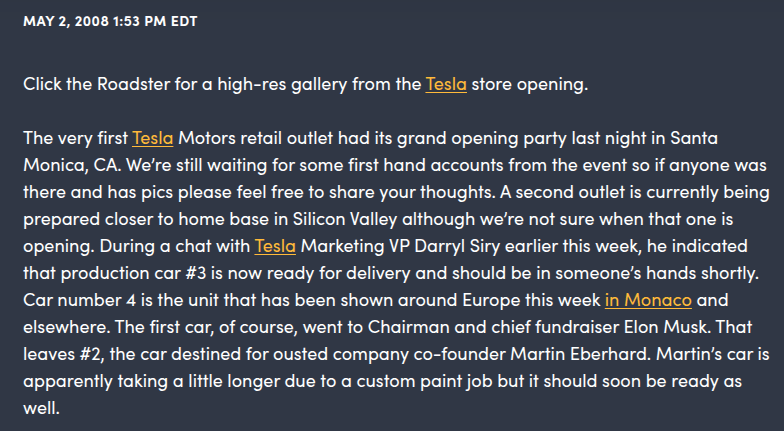
First Tesla Roadster delivered to Elon Musk
Third Launch of Falcon 1 ends in failure
With 25 minutes left in the launch window, the Falcon 1 lifted off from Omelek Island at 03:35 UTC. During the launch, small vehicle roll oscillations were visible. Stage separation occurred as planned, but because residual fuel in the new Merlin 1C engine evaporated and provided transient thrust, the first stage recontacted the second stage, preventing successful completion of the mission.
Wikipedia – Falcon 1
Justine Wilson announces divorce from Musk
via LiveJournal (Archive)
Fourth times the charm, Falcon 1 reaches orbit
Falcon 1 became the first “privately funded and developed” liquid-propellant rocket to reach orbit. (Wiki – Falcon 1)

SpaceX is saved by timely $1.6 Billion Government Contract
CONTRACT RELEASE: C08-069; NASA Awards Space Station Commercial Resupply Services Contracts
WASHINGTON — NASA has awarded two contracts — one to Orbital Sciences Corp. of Dulles, Va., and one to Space Exploration Technologies (SpaceX) of Hawthorne, Calif. — for commercial cargo resupply services to the International Space Station. At the time of award, NASA has ordered eight flights valued at about $1.9 billion from Orbital and 12 flights valued at about $1.6 billion from SpaceX.
These fixed-price indefinite delivery, indefinite quantity contracts will begin Jan. 1, 2009, and are effective through Dec. 31, 2016. The contracts each call for the delivery of a minimum of 20 metric tons of upmass cargo to the space station. The contracts also call for delivery of non-standard services in support of the cargo resupply, including analysis and special tasks as the government determines are necessary.
NASA has set production milestones and reviews on the contracts to monitor progress toward providing services. The maximum potential value of each contract is about $3.1 billion. Based on known requirements, the value of both contracts combined is projected at $3.5 billion.
These agreements will fulfill NASA’s need to procure cargo delivery services to the space station using a U.S. commercial carrier after the retirement of the space shuttle.
Archive – NASA Press Release
... In the meantime, at SpaceX, Musk and top executives had spent most of December in a state of fear, but on Dec. 23, 2008, SpaceX received a wonderful shock. The company won a $1.6 billion contract for 12 NASA resupply flights to the space station. Then the Tesla deal ended up closing successfully, on Christmas Eve, hours before Tesla would have gone bankrupt. Musk had just a few hundred thousand dollars left and could not have made payroll the next day.
Elon Musk’s Space Dream Almost Killed Tesla (Ashlee Vance; 5/15/2015)
2009
PlanetSpace files formal protest with GAO
Tesla founder sues Tesla CEO
Tesla receives $465M government loan
Tesla was approved to receive $465 million in interest-bearing loans from the United States Department of Energy. The funding, part of the $8 billion Advanced Technology Vehicles Manufacturing Loan Program, supported the engineering and production of the Model S sedan, as well as the development of commercial powertrain technology. Tesla repaid the loan in May 2013, with $12 million in interest.
Wikipedia
Fifth launch successful; Falcon 1 retired
Lawsuit resolution allows Musk to call himself a “founder” of Tesla
2010
Tesla announces purchase of factory in Fremont, CA
Successful first launch of Falcon 9
On June 4, 2010, the first Falcon 9 launch successfully placed a test payload into the intended orbit. (Wiki – Falcon 9
Tesla goes Public
Grand opening on Fremont factory to begin production on Model S
Successful COTS Demo – Dragon Space Capsule
2011
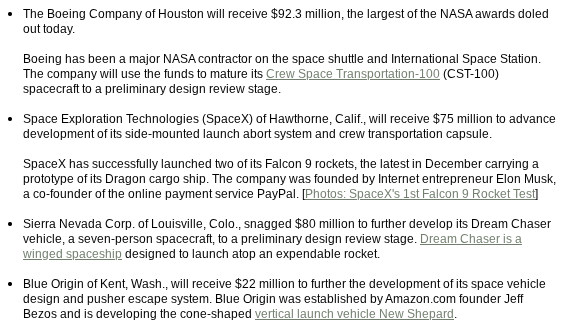
SpaceX awarded $75 Million in NASA Funds
2012
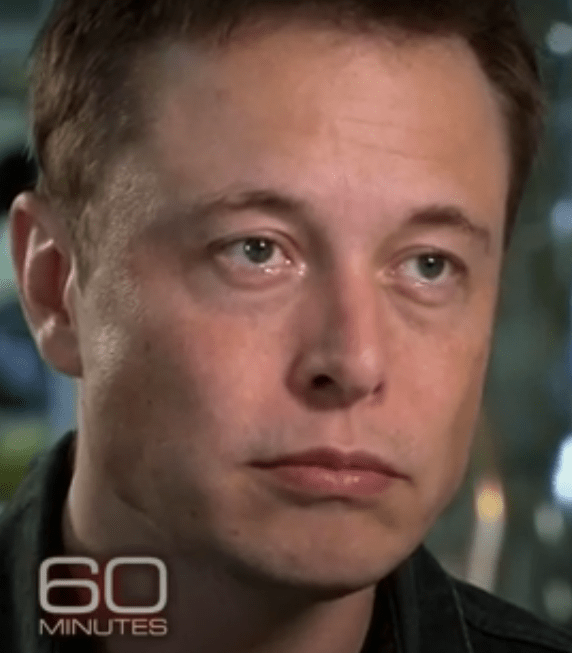
Musk cries on 60 Minutes
… in response to Musk’s ”heroes’, Apollo astronauts Neil Armstrong and Eugene Cernan, testifying in front of Congress regarding Musk’s commercial space endeavors — “now is time to overrule this administration’s pledge to mediocrity,” said Cernan.
First commercial delivery of cargo to ISS / Valuation doubles

After the flight, SpaceX’s private equity valuation nearly doubled to $2.4 billion
Tesla launches second car – Model S Luxury Sedan
2013
Tesla Joins NASDAQ-100
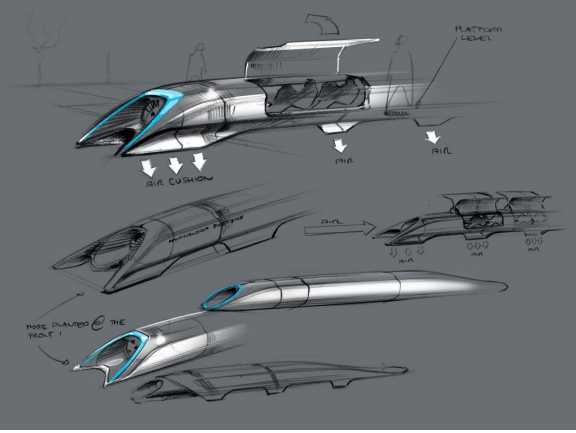
Musk Blogs to derail California’s plans for high speed rail
Musk borrows a page from The Simpsons – (Archived) – Tesla Motors: Hyperloop
This was three and a half years before the founding of the Boring Company, and it was a proposal from the “Tesla CEO” at the time.

2014
Musk advises long-term Pickup Truck plan
To compete with Ford F150, “4-5 years” out
Model X: Delayed again until 2015
Based on everything I read on Tesla’s very early days, and what Musk has insisted the whole world learn about him, is there any doubt about the reason for the delays.
During an interview with Bloomberg prior to Tesla’s earnings call yesterday, CEO Elon Musk discussed a few interesting tidbits. The most significant revelation is that the Model X SUV, which was first detailed in 2012 and originally set to begin production late last year, is now delayed until 2015. Musk cited several reasons for the delay, such as a need to focus on Model S distribution efforts, including expanding sales to China, along with his own personal dissatisfaction with current prototypes. Tesla also needs to boost battery production before it can roll out SUVs at a speedy enough pace to meet demand, which Musk expects will exceed Model S adoption.
It is this part: “it’s damn hard to make an SUV… that is beautiful and yet incredibly functional at the same time” that seems to make it certain he was insisting on the douchebag doors.

Engadget.com (Archived)
Senate hearing on National Security Space Launch Programs w/ Elon Musk
A product teaser and a dick joke
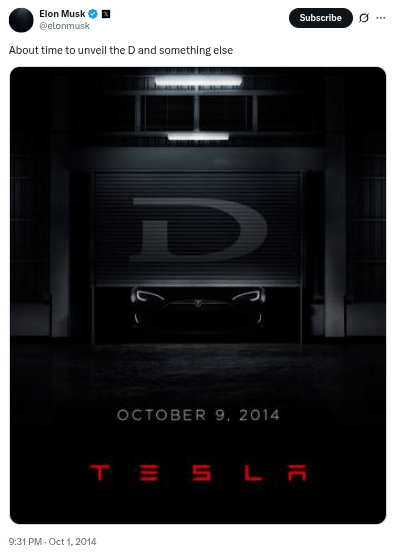
The “Model D”; first AutoPilot offered (HW1)
He makes a joke about his pants having Velcro inseams, but says the D stands for Dual Motor., not Distraction
“This car is nuts,” he said during the reveal. “It’s like taking off from a carrier deck. It’s just bananas. It’s like having your own personal roller coaster.”
Business Insider

Morgan Stanley analyst Adam Jonas calls Tesla “the world’s most important car company.”
Business Insider (Archived)
Model X: Delayed again until Q3 2015
2015
Falcon 9 Launches, Failure to Land
Space.com – SpaceX’s Elon Musk Says Rocket Landing Test Ran Out of Hydraulic Fluid
$1 Billion Funding Round; 12 Billion Valuation
Tesla enters energy storage market w/ battery packs
Powerwall (Home) and Powerpack (Business) unveiled
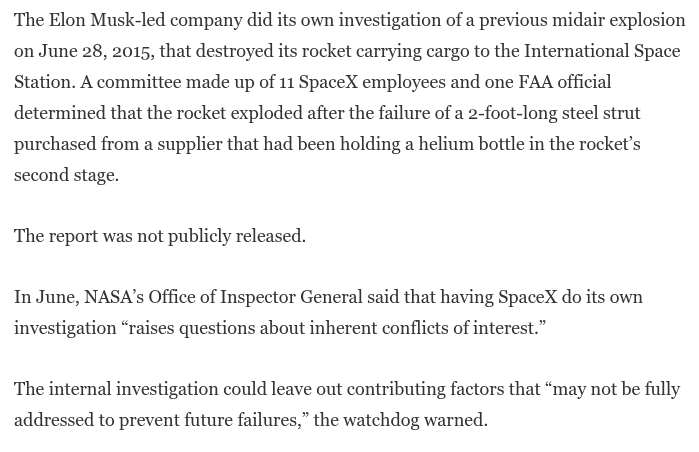
Falcon 9 Mid-air explosion – SpaceX investigates itself
Falcon 9’s first major failure, seventh ISS re-supply mission.
Musk cries in Interview for Danish TV
“Creating a company is almost like having a child. So how do you say your child shouldn’t have food?” – Elon Musk
It’s somewhat surprising how often he cries in interviews.
This LinkedIn Post says everything about how the Myth of Musk has been sustained. Perspective is indeed everything.

Musk appears on Stephen Colbert
Tesla delivers first Model X SUVs
Musk announces new non-profit with Peter Thiel, OpenAI
Falcon 9 Launch and Landing Success
The successful landing of the first stage at Landing Zone 1, near the launch site, was the result of a five-year technology development program to develop a reusable launch system and came on a flight test that followed the primary launch mission. Following separation of the second stage, SpaceX conducted the eighth of its controlled booster descent tests of the spent first stage, the first in which the descent target location was on land, and also the first ever successful landing.
Wikipedia – Falcon 9 flight 20
2016
SpaceX purchases $90M in SolarCity Stock
SEC Filling (Archived)
Tesla unveils Model 3
Tesla says 325,000 Model 3 Reservations
Met Gala: Elon Musk meets Amber Heard

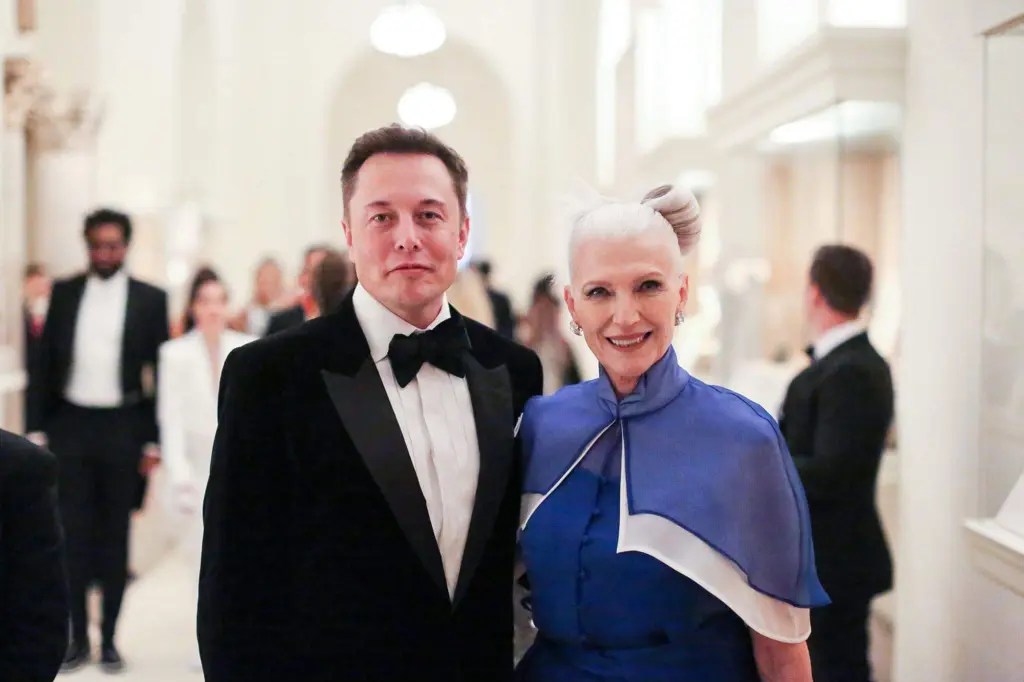
… He’d been trying to meet her for a few years. People – Relationship Timeline
Code Conference – Bold Claims
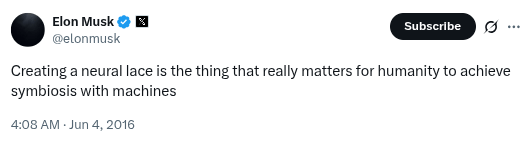
Musk’s initial Neuralink pitch was far more science fiction than the brain implants that had already been done: “Neural Lace”
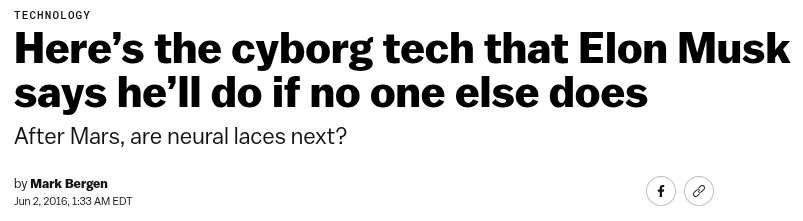
Humanity needs cyborgs
Musk’s one and only tweet referencing a “neural lace” by that term.
Neuralink Founded
“Neuralink, founded on June 21, 2016, is a pioneering company in the field of brain-machine interfaces. Located in Fremont, California, the company aims to develop high-bandwidth interfaces that monitor and stimulate brain activity.
The founders of Neuralink include Dongjin Seo, Elon Musk, Lisa Li, and Max Hodak. Their mission is to create devices that assist people with paralysis and to invent new technologies that expand human capabilities.
With a team of 251-500 employees, Neuralink is dedicated to pushing the boundaries of neuroscience and technology to improve lives and foster innovation.”
clay.com
7:41 PM (ET) – Elon’s Jet departs Van Nuys, CA ✈️
4:43 AM (ET) – Elon’s Jet arrives London, England ✈️ 🇬🇧
4:43 AM (ET) – Elon’s Jet departs London, England ✈️ 🇬🇧
12:56 AM (ET) – Elon’s Jet arrives Cape Town, SA ✈️ 🇿🇦
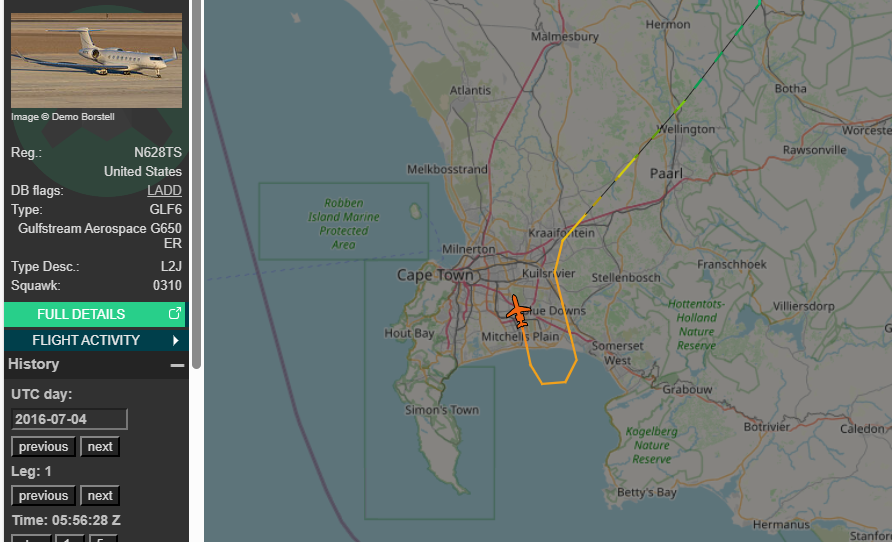
3:03 AM (ET) – Elon’s Jet departs Cape Town, SA ✈️ 🇿🇦

7:33 AM (ET) – Elon’s Jet arrives Johannesberg, SA ✈️ 🇿🇦
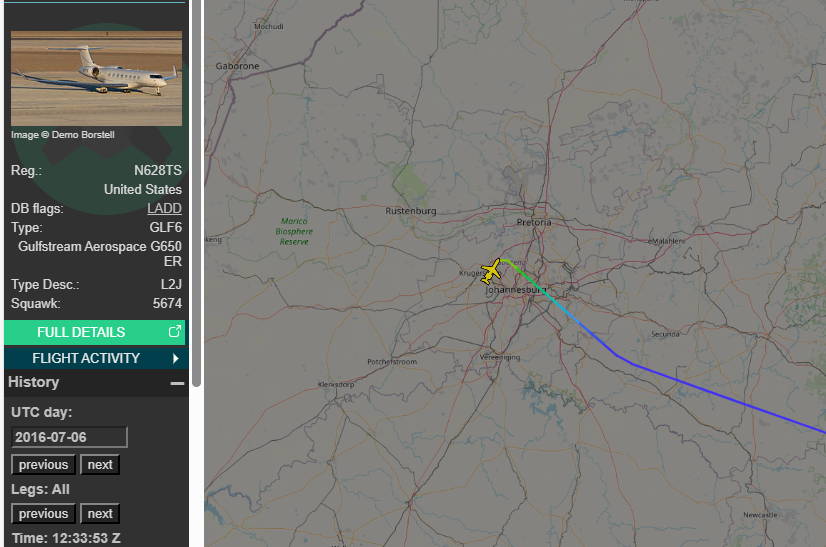
12:48 AM (ET) – Elon’s Jet departs Johannesberg, SA ✈️ 🇿🇦
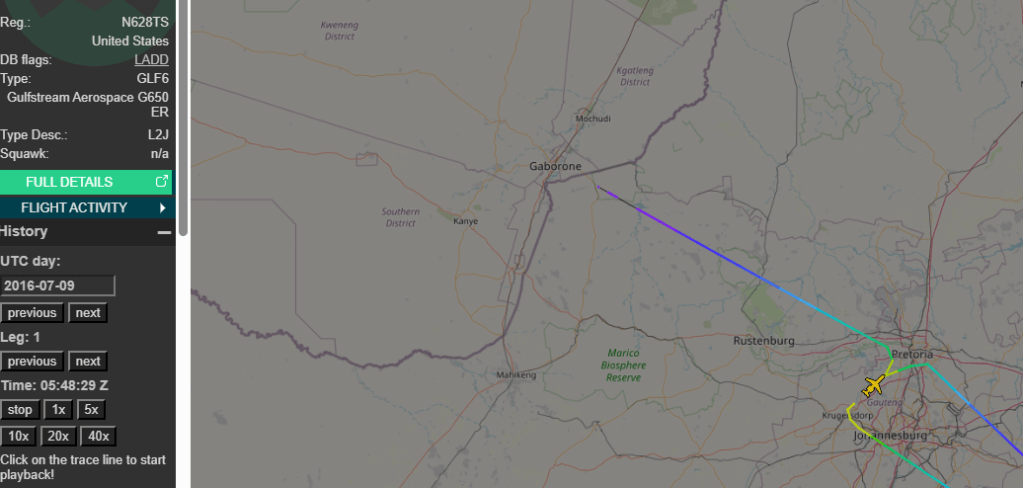
12:10 AM (ET) – Elon’s Jet arrives, Van Nuys, CA ✈️

Master Plan – Part Deux: Solar Roofs, Semis & Pickups, Self-Driving & Car Sharing
Blog by Elon Musk (Archived)
10 years after Part 1, Musk’s follow-up again cites SolarCity, and Tesla’s need to acquire it. SolarCity began in 2006 and was co-founded by Lyndon Rive and Peter Rive, Musk’s cousins.

9:07 PM (ET) – Elon’s Jet departs Van Nuys, CA ✈️
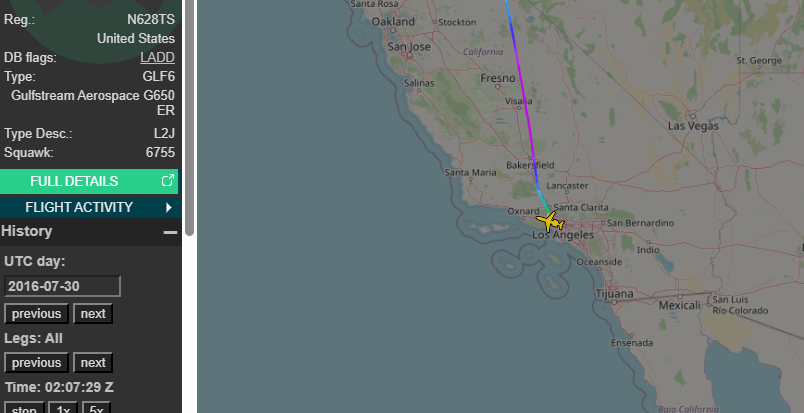
10:12 AM (ET) – Elon’s Jet arrives London ✈️ 🇬🇧
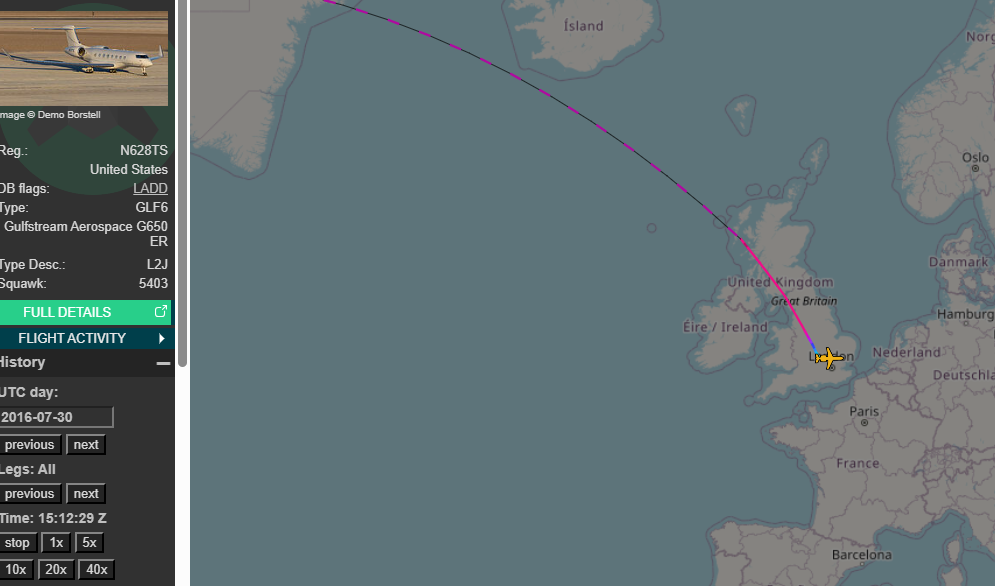
10:07 AM (ET) – Elon’s Jet departs London ✈️ 🇬🇧
5:54 AM (ET) – Elon’s Jet arrives Teterboro (NJ) ✈️
10:05 AM (ET) – Elon’s Jet departs Teterboro (NJ) ✈️
3:44 PM (ET) – Elon’s Jet arrives London ✈️ 🇬🇧
7:47 AM (ET) – Elon’s Jet departs London ✈️ 🇬🇧
5:31 PM (ET) – Elon’s Jet arrives San Jose, CA ✈️
12:11 PM (ET) – Elon’s Jet departs London ✈️ 🇬🇧
3:21 PM (ET) – Elon’s Jet arrives Monaco ✈️ 🇲🇨
11:25 AM (ET) – Elon’s Jet departs Monaco ✈️ 🇲🇨
2:55 PM (ET) – Elon’s Jet arrives London ✈️ 🇬🇧
10:30 AM (ET) – Elon’s Jet departs London ✈️ 🇬🇧
9:58 PM (ET) – Elon’s Jet arrives LAX ✈️
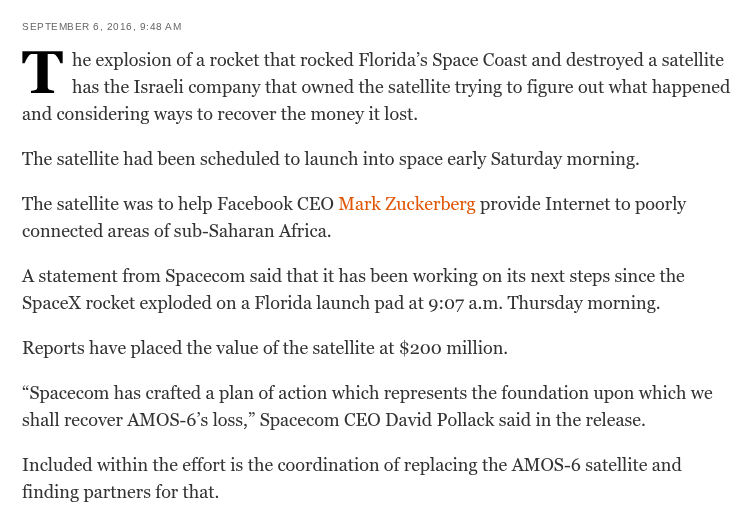
Launchpad Explosion; $200M Israeli satellite destroyed
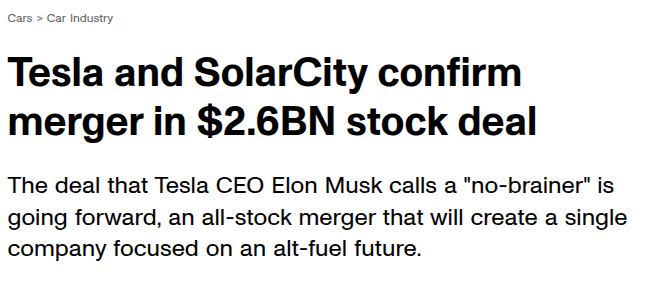
SolarCity Acquisition approved with 85% of shareholders
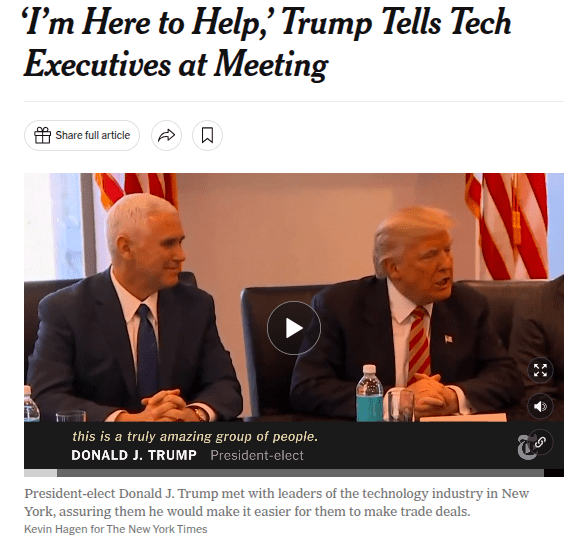
Trump Meets with ‘Tech Elite’ in NYC
Among others, the gathering included:
- Mike Pence
- Peter Thiel
- Jeff Bezos
- Elon Musk
- Tim Cook of Apple
- Sheryl Sandberg of Facebook
- Larry Page of Google
- Eric Schmidt of Google
- Satya Nadella of Microsoft
- Don Trump, Jr
- Eric Trump
- Ivanka Trump
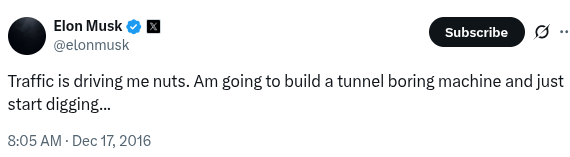
Musk announces plans to tunnel, cites LA traffic


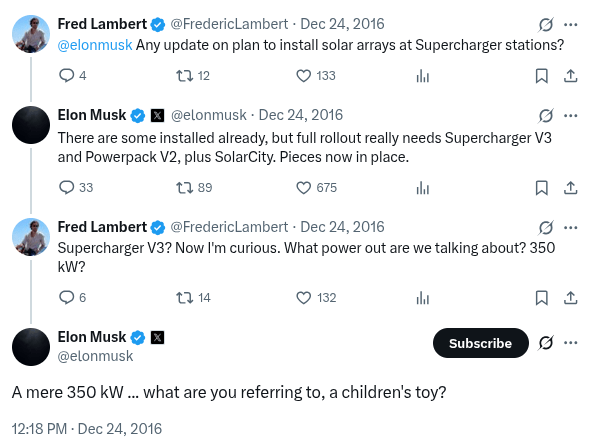
Some “puffery” about V3 Superchargers
(for context: V3 was introduced in 2019, “peak rates of up to 250 kW”)
Electric jet and existential dread
Merry Christmas.

2017
Q1 2017
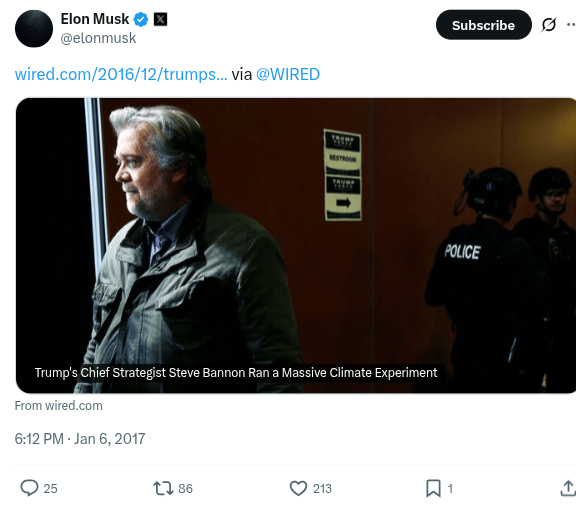
Musk tweets article about Steve Bannon & Biosphere 2
One of the more prominent white nationalists tied to Trump 1.0, back before Trump (and the GOP) would so openly embrace white nationalism. Musk seemed to like his climate change experience too.
New Yorker: “Elon Musk has delivery issues”

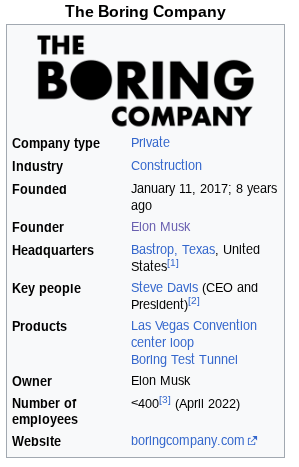
The Boring Company is founded
Musk endorses Rex Tillerson for Secretary of State
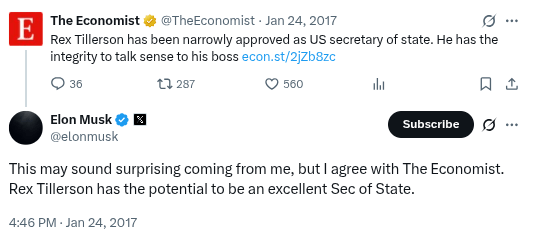
My tweets speak for themselves. Please read them exactly as they are written. Tillerson obviously did a competent job running Exxon, one of the largest companies in the world. In that role, he was obligated to advance the cause of Exxon and did. In the Sec of State role, he is obligated to advance the cause of the US and I suspect he probably will. Also, he has publicly acknowledged for years that a carbon tax could make sense. There is no better person to push for that to become a reality than Tillerson. This is what matters far more than pipelines or opening oil reserves. The unpriced externality must be priced.
Gizmodo Interview
Musk announces plan to start digging “in a month or so”

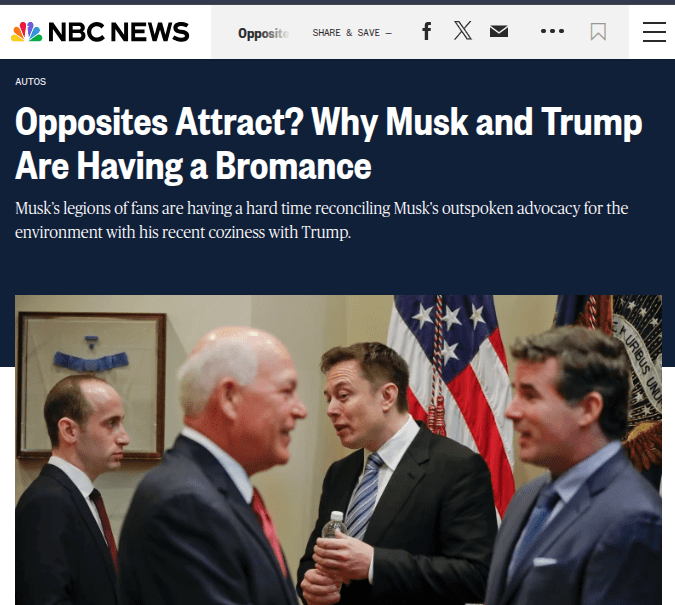
NBC News fails to see what Musk & Trump have in common
… total opposites.
Just a smol bean
The tweet he’s replying to is gone, but context seems to be about displeasure over his involvement with Trump.
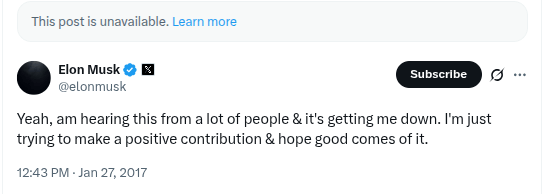
Musk meekly challenges “Muslim Ban”

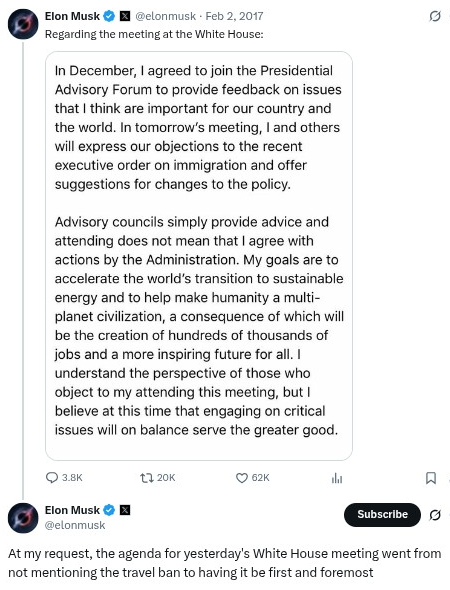
Musk crowd sources immigration suggestions to present to Trump 1.0
It’s sort of cute how when his net worth was only $20 Billion, he had to say things like “seek consensus”. Less than eight years later, he had the funds to buy Trump outright.

Humans can only beat SkyNet by becoming machines
… it’s always an existential crisis if this guy doesn’t get hundreds of millions of dollars.

Tesla Motors officially renamed Tesla
Musk defends joining Presidential advisory council

Musk warns humans must merge with machines
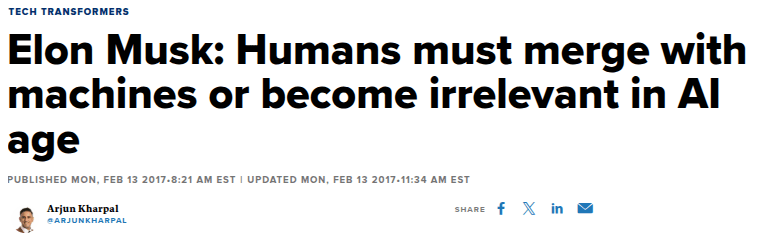
Billionaire Elon Musk is known for his futuristic ideas and his latest suggestion might just save us from being irrelevant as artificial intelligence (AI) grows more prominent.
The Tesla and SpaceX CEO said on Monday that humans need to merge with machines to become a sort of cyborg.
“Over time I think we will probably see a closer merger of biological intelligence and digital intelligence,” Musk told an audience at the World Government Summit in Dubai, where he also launched Tesla in the United Arab Emirates (UAE).
“It’s mostly about the bandwidth, the speed of the connection between your brain and the digital version of yourself, particularly output.”
First private space launch from NASA facility – Falcon 9
SpaceX 10th resupply mission to the International Space Station.

Sunday’s launch was the culmination of two prior launches that ended in disaster. Last September, an explosion on the launchpad destroyed both a rocket and its satellite, while a separate attempt in June 2015 blew up shortly after liftoff.
“Elon Musk is Running Out of Money”
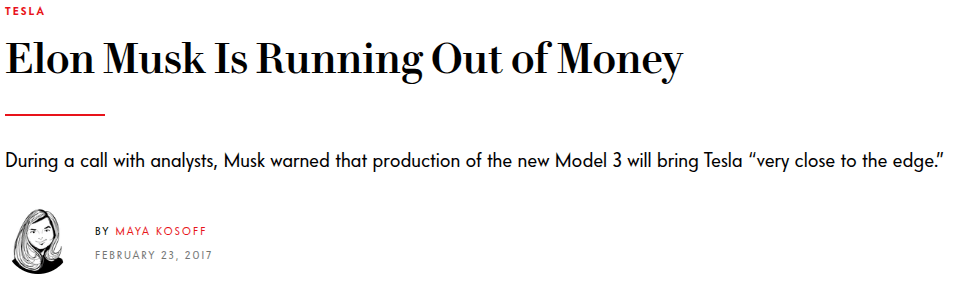
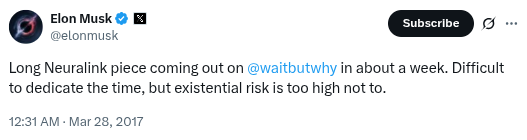
“Existential Risk” posed by Musk not raising funds for Neuralink
… it’s always an existential crisis if this guy doesn’t get hundreds of millions of dollars.
Q2 2017
Musk and Amber Heard go Instagram official

TED Talk: “The future we’re building — and boring”
Musk and Amber Heard out together in Australia

Musk’s sources of pure joy are mostly illegal

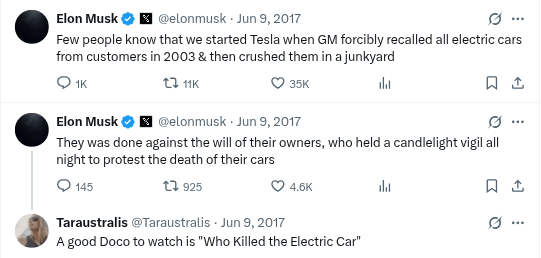
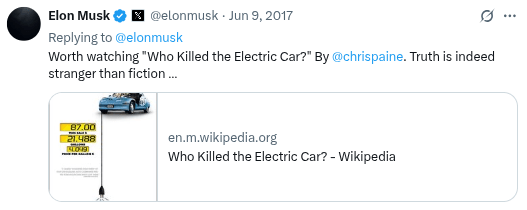
Company Origin story, ‘Who Killed the Electric Car?”
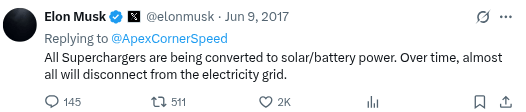
Casual Musk Lie “All Superchargers are being converted to battery/solar power”
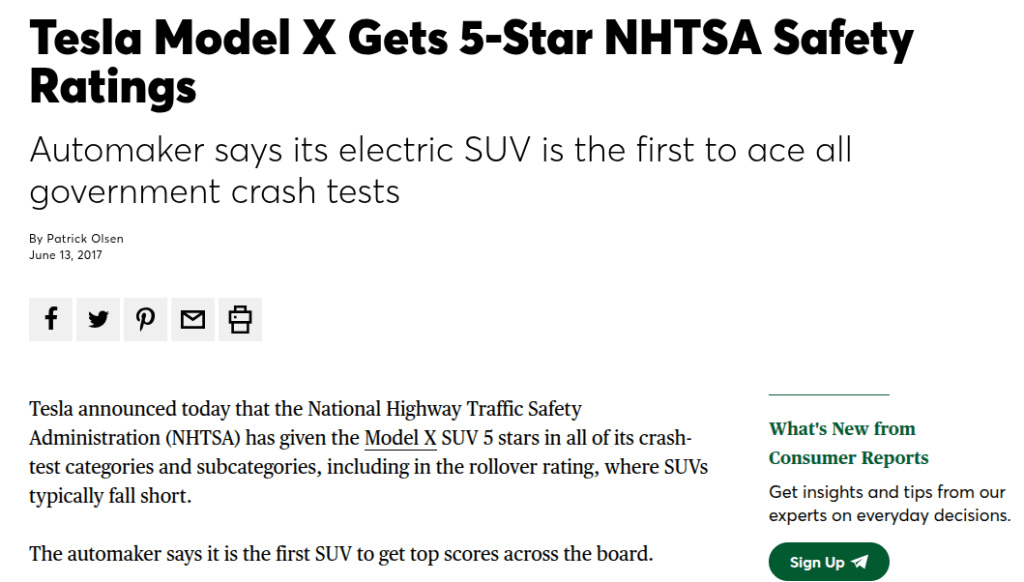
NHTSA gives Model X 5-star safety rating
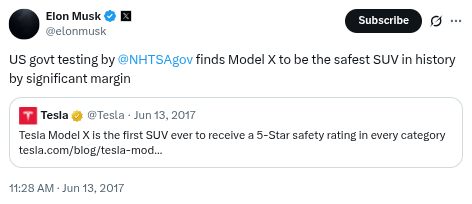
Musk seems to be over-stating it — as he does — and the higher rating is due entirely to SUVs having a typically higher center of gravity and tendency to rollover.
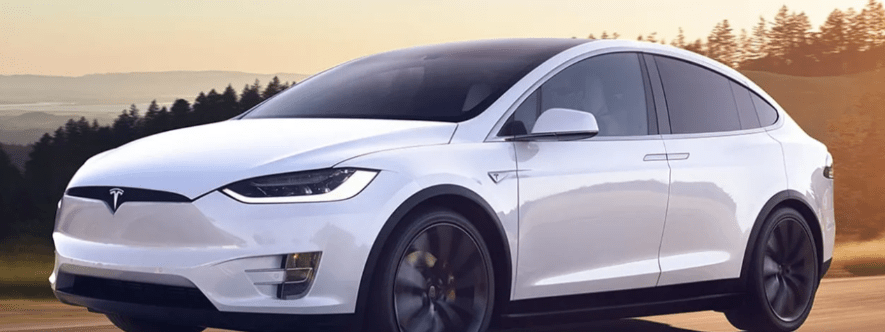
Looking at the Model X… it seems like they left the V and stretched on the S and the U.
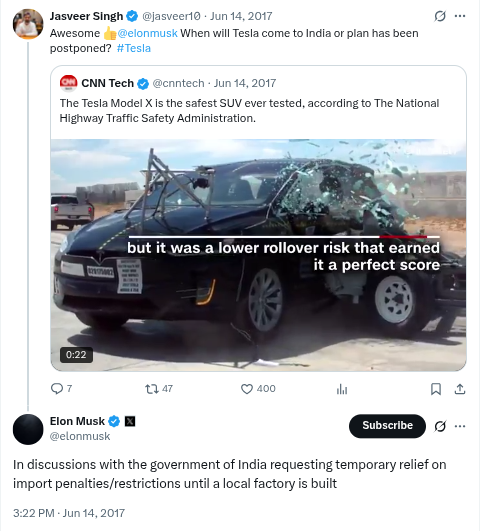
Musk in talks with Indian government to change the rules for him
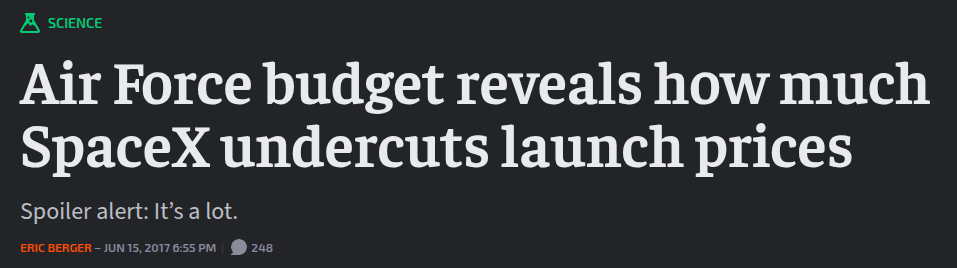
Air Force Contract: SpaceX launch $300M less than Boeing/Lockheed


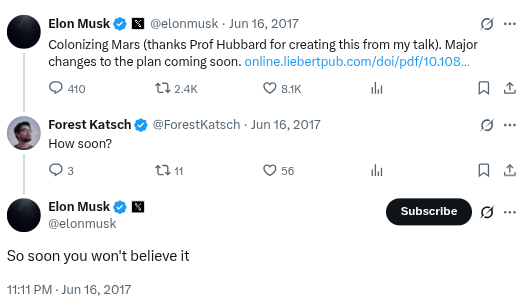
How soon to colonize Mars? “So soon you won’t believe it”
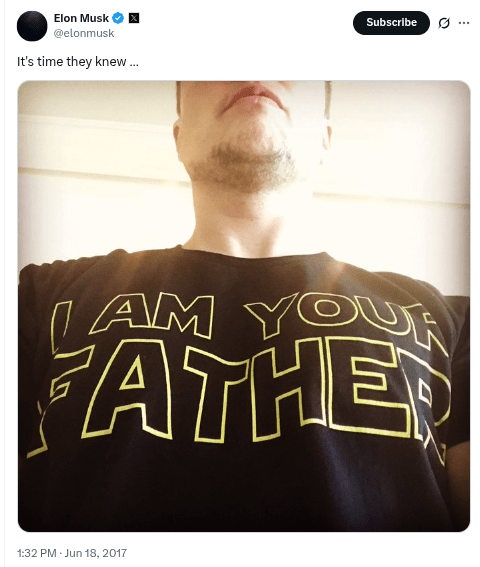
Musk’s T-shirt humor – “I am your father”
I’m not sure who “they” might be in this tweet, but some years later we would learn of his instance on some baby mamas keeping his name off the birth certificate.
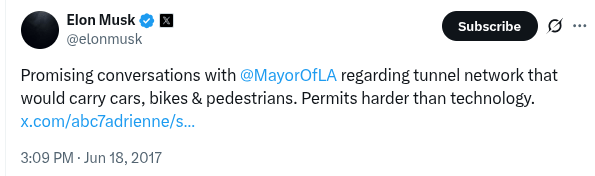
Musk claims to be in talks for tunneling under LA
Somewhat puzzling why Musk would think that permission to dig a network of tunnels under LA could (or should) be easy.
Max Smart and Chaos Poll
… I don’t know why this one is about.

The video: https://www.youtube.com/watch?app=desktop&v=hHrnLOb1hTA
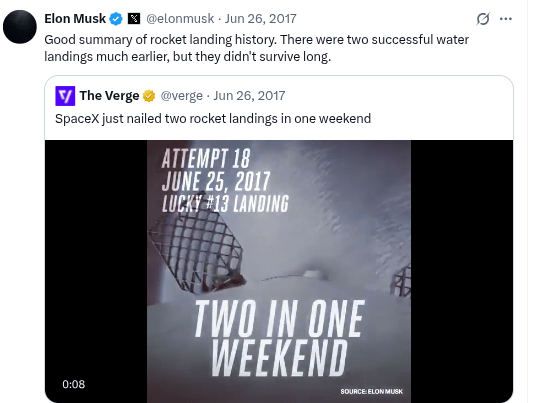
Two successful rocket landings in one weekend
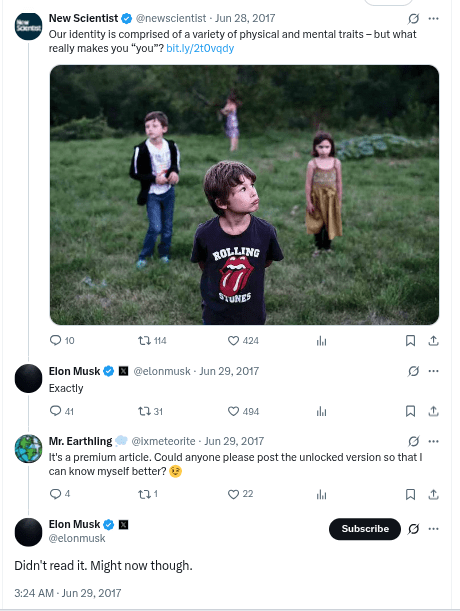
“Exactly”, says Musk, on an article he didn’t read.
It’s not even that Musk would promote an article he hasn’t read, there’s not even a declarative statement in the tweet for him to agree with.
… and you know he still didn’t read it after the follow-up tweet.
Waiting for Godot
Although I’m unable to see the tweet he’s replying to, it could be anything really.
I remember two things about my father’s performance in the play, when I was a young teenager — 1) My Dad saying the word erection, because gross, and 2) Godot never shows up. This was memorable because of how frustrating it was to me, which seemed to make my father happy because it meant I’d been paying attention.

Q3 2017
Musk reclaims domain X.com for “nostalgia”
No word on the pricetag on nostalgia
CNBC – Elon Musk now owns X.com, the defunct domain of his second startup
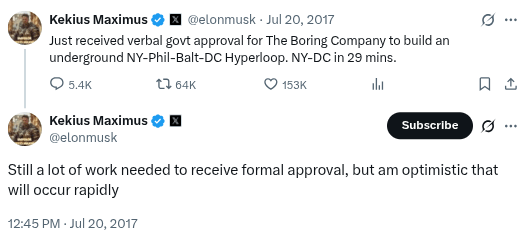
NY-DC in 29 Minutes – Musk claims “verbal” government approval
There was no approval, no real plan, and this was never going to happen.
$350 Million in new funding; SpaceX valued at $21 Billion

Musk and Amber Heard break up
Word is, he initiated it. https://people.com/celebrity/amber-heard-elon-musk-split/
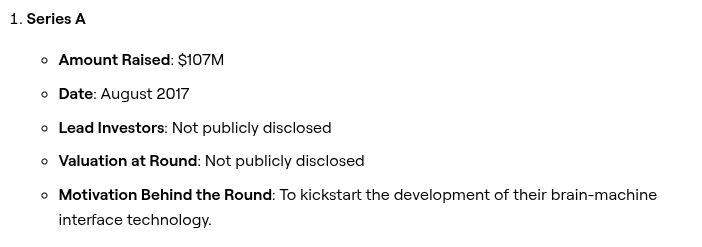
$107 Million Series A funding for Neuralink
Q4 2017
Musk registers “Pravda Corp”, a nod to Soviet newspaper
“Pravda, meaning “truth” in Russian, was primarily known as the official newspaper of the Communist Party of the Soviet Union. It served as a key propaganda tool, disseminating the Party’s ideology and suppressing dissent. Subscription to Pravda was even mandatory for many organizations, including state-run companies and the military, until 1989.”
Wikipedia

Musk cries about energy crisis on 60 Minutes
Musk is so saddened to hear of the energy crisis in Australia, he cries. Chin quiver and everything.
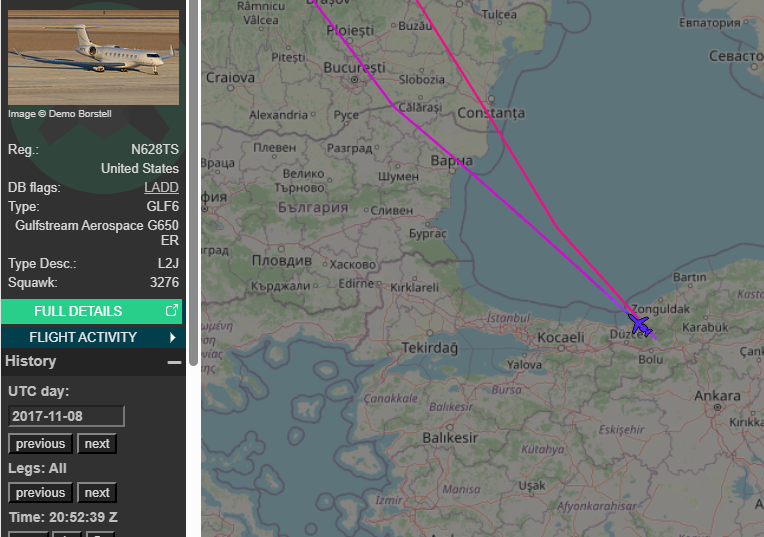
~6:28 AM (ET) – Elon’s Jet arrives Turkey ✈️
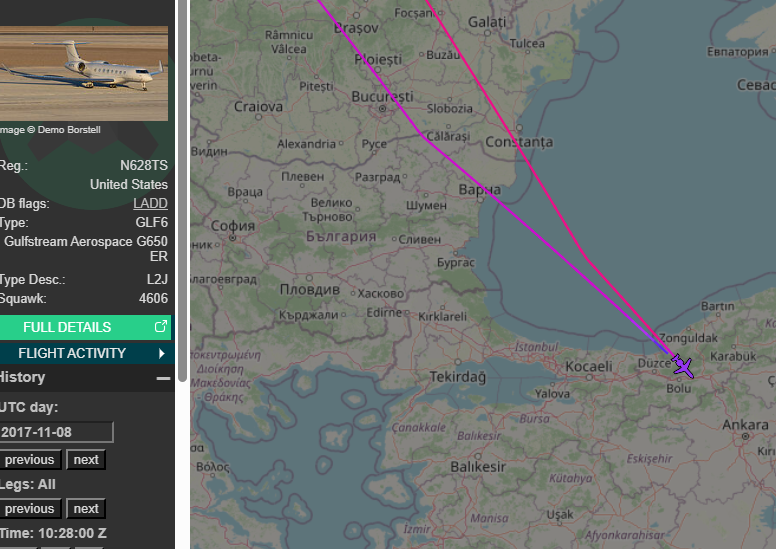
2:52 PM (ET) – Elon’s Jet departs Turkey ✈️
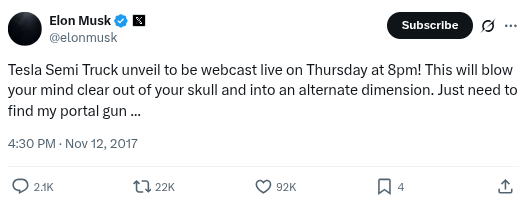
Tesla Semi? More like Tesla Full Mast!
Musk talks to Rolling Stone about Amber Heard heartbreak

Elon Musk Opens Up About His Breakup with Amber Heard: ‘It Hurt Bad’
Tesla Semi unveiling and Roadster 2 Proto-hype
The Semi: 0-60 in 5 seconds, 20 seconds fully loaded. 500 Miles on a single charge. Glass that would survive a thermonuclear explosion. Solar-powered mega chargers. Guaranteed to not break down for 1 million miles.
“Production begins 2019. So if you order now, you get the truck in two years.” – Elon Musk
Car & Driver: “Elon Shows Us His Semi” (I hate how much everyone leaned into his gross sex jokes.)
28 Minutes, he comes back to the stage for an encore.
“People have asked us for a very long time – “When are you going to make a new Roadster? We are making it now.”
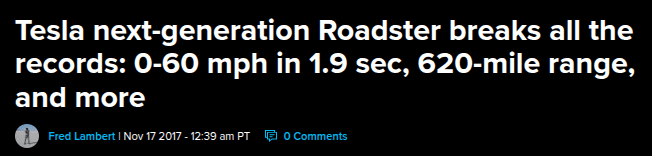
Elon Musk surprised everyone at the Tesla Semi unveiling with his “one more thing” being a prototype of the next generation Roadster.
They not only unveiled the stunning design of Tesla’s new sports car, but they also announced some mind-boggling specs that are sure to break a lot of records.
9:26 PM (ET) – Elon’s Jet departs Seattle, WA ✈️

9:26 PM (ET) – Elon’s Jet departs Seattle, WA ✈️
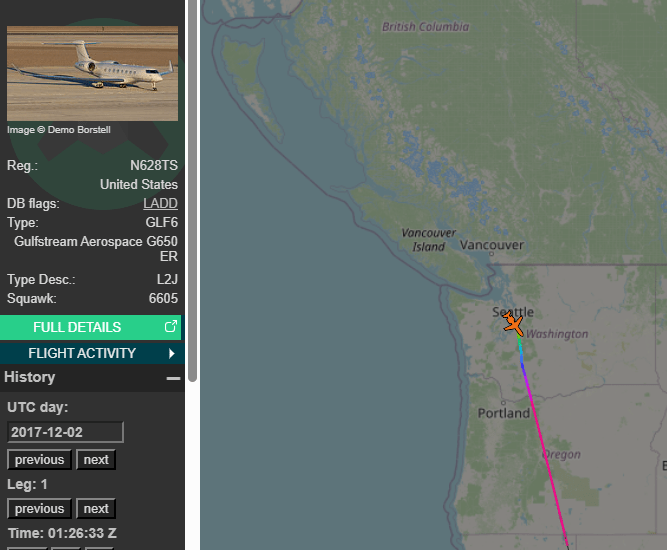
11:23 PM (ET) – Elon’s Jet arrives Van Nuys, CA ✈️
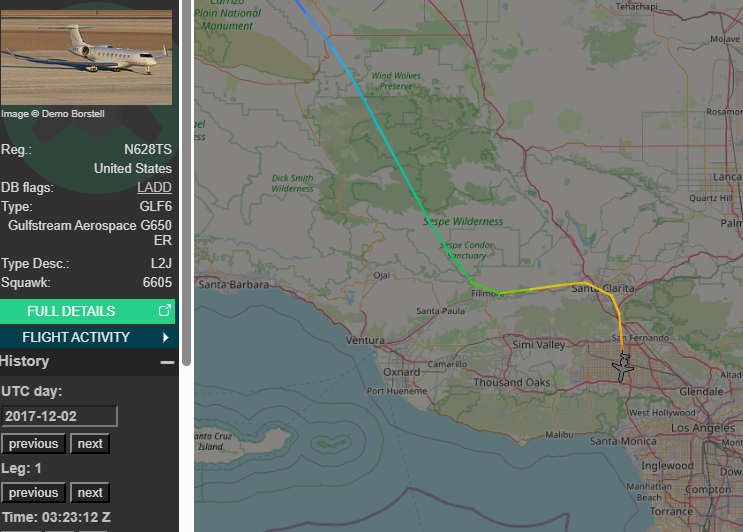
5:28 PM (ET) – Elon’s Jet departs Van Nuys, CA ✈️
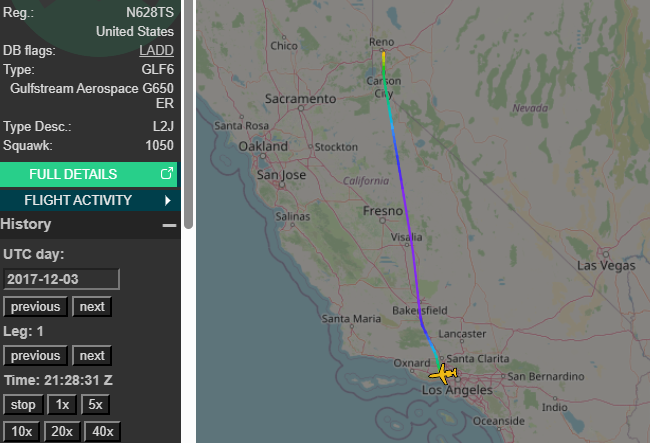
6:17 PM (ET) – Elon’s Jet arrives Reno, NV ✈️

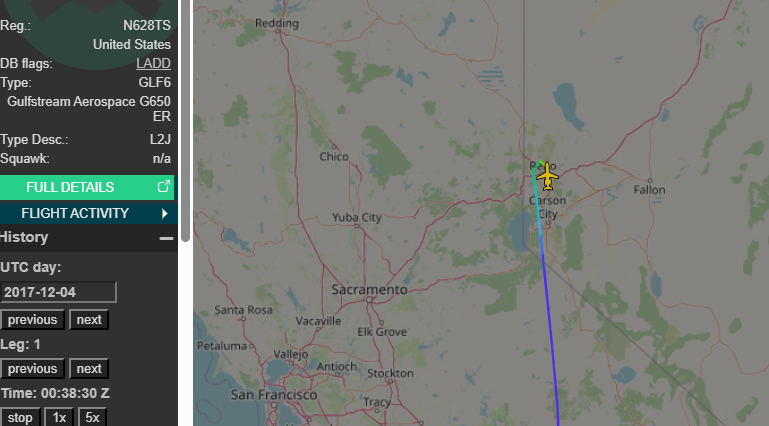
8:38 PM (ET) – Elon’s Jet departs Reno, NV ✈️
To the Moon: Trump Signs Directive to send Humans back
The Directive “provides for a U.S.-led, integrated program with private sector partners for a human return to the Moon, followed by missions to Mars and beyond.”
NASA Press Release (Archived)

“As the next major step to return astronauts to the Moon under Space Policy Directive-1, NASA announced plans on Dec. 13 to work with American companies to design and develop new reusable systems for astronauts to land on the lunar surface. The agency is planning to test new human-class landers on the Moon beginning in 2024, with the goal of sending crew to the surface in 2028.
Through multi-phased lunar exploration partnerships, NASA is asking American companies to study the best approach to landing astronauts on the Moon and start the development as quickly as possible with current and future anticipated technologies.“
3:52 PM (ET) – Elon’s Jet departs San Francisco ✈️
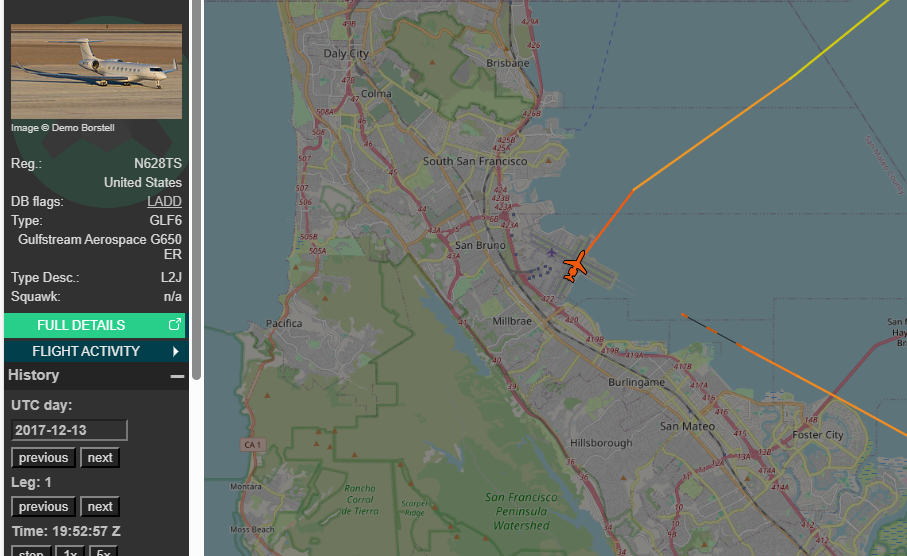
4:24 PM (ET) – Elon’s Jet arrives Reno, NV ✈️
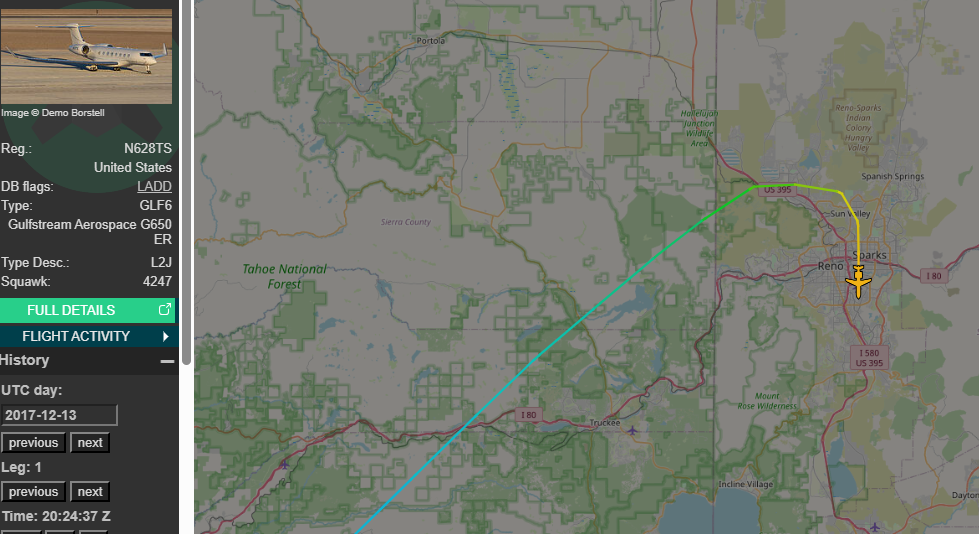
9:30 PM (ET) – Elon’s Jet departs Reno, NV ✈️
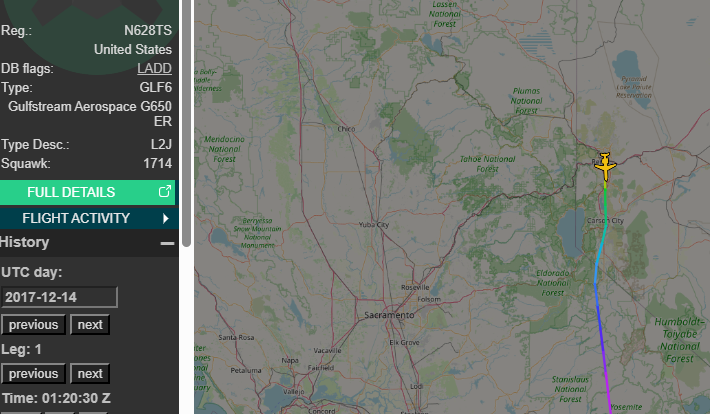
10:14 PM (ET) – Elon’s Jet arrives Van Nuys, CA ✈️

10:25 PM (ET) – Elon’s Jet arrives Reno, NV ✈️
1:49 AM (ET) – Elon’s Jet departs Reno, NV ✈️
2:36 AM (ET) – Elon’s Jet arrives Van Nuys, CA ✈️
2:36 AM (ET) – Elon’s Jet arrives Van Nuys, CA ✈️
2:25 PM (ET) – Elon’s Jet departs Van Nuys, CA ✈️
3:17 PM (ET) – Elon’s Jet arrives San Francisco ✈️
4:23 PM (ET) – Elon’s Jet departs San Francisco ✈️
4:52 PM (ET) – Elon’s Jet arrives Reno, NV ✈️
9:53 PM (ET) – Elon’s Jet departs Reno, NV ✈️
10:45 PM (ET) – Elon’s Jet arrives Van Nuys, CA ✈️
6:28 PM (ET) – Elon’s Jet departs Van Nuys, CA ✈️
7:21 PM (ET) – Elon’s Jet arrives Reno, NV ✈️
10:14 PM (ET) – Elon’s Jet departs Reno, NV ✈️
11:06 PM (ET) – Elon’s Jet arrives Van Nuys, CA ✈️
1:01 AM (ET) – Elon’s Jet departs Van Nuys, CA ✈️
11:09 AM (ET) – Elon’s Jet arrives Santiago, Chile ✈️ 🇨🇱
6:30 AM (ET) – Elon’s Jet departs Santiago, Chile ✈️ 🇨🇱
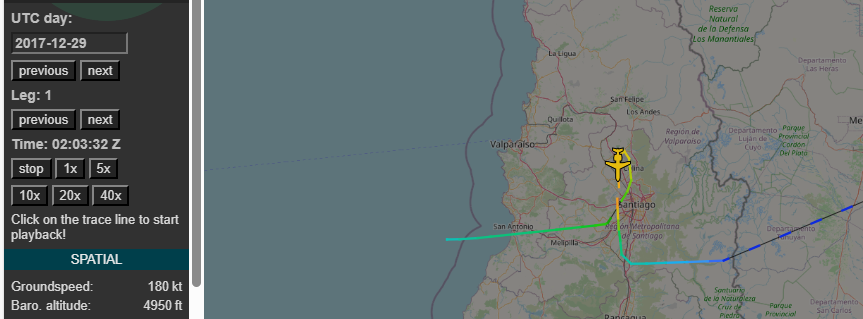
10:03 PM (ET) – Elon’s Jet arrives Santiago, Chile ✈️ 🇨🇱
?
 The Dittmann Files